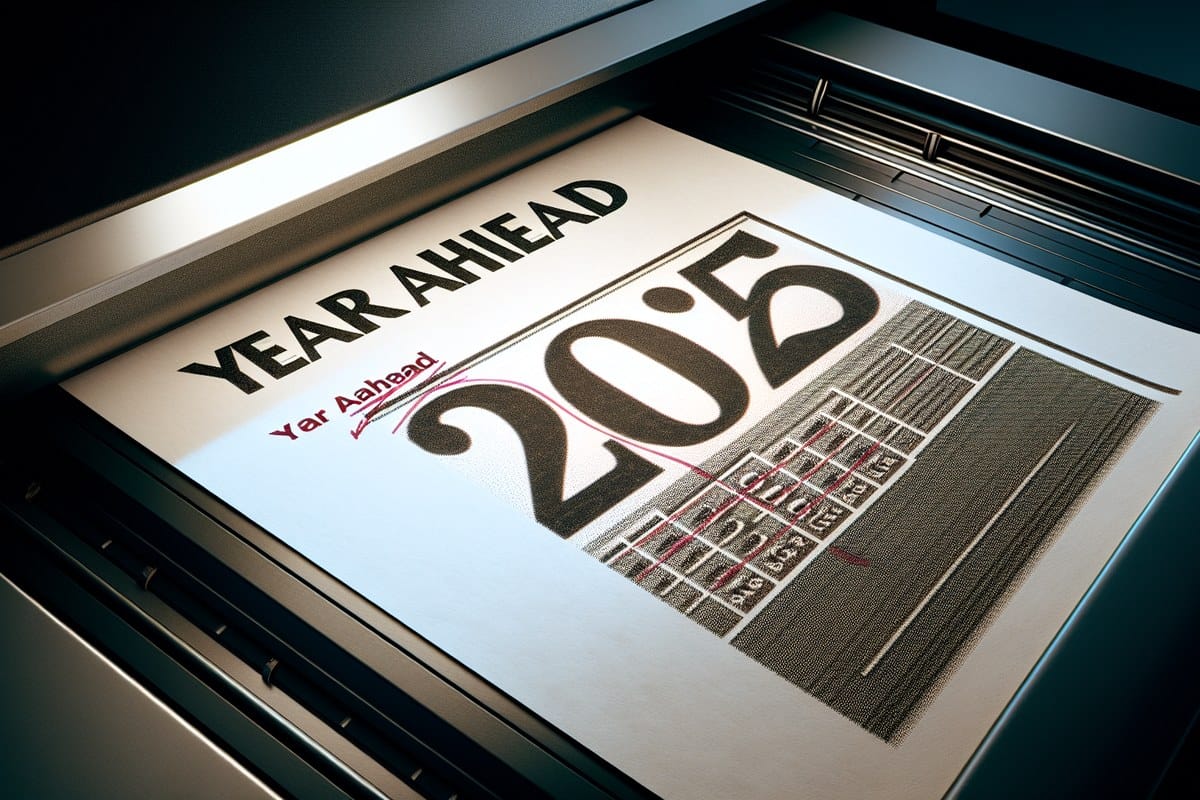
NEW YORK, NY — At 11:47 p.m. Monday, a second-year associate named Jasper Yoon hit Ctrl+H on a 312-page PDF, typed “2025” in the top field and “2026” in the bottom, clicked Replace All, and produced what Goldman Sachs published Tuesday morning as its flagship Year Ahead: Conviction Themes for 2026.
The 312-page document, released to clients with a complimentary leather-look folio and a QR code linking to the same PDF, makes 41 specific calls about the coming year, all of which were also made about the previous year, in the same order, in the same Helvetica Neue 11pt, beneath the same chart of an arrow going up and slightly to the right.
One footnote on page 184 still reads “as of Q3 2024.” A bar chart on page 92 is labeled “Source: Goldman Sachs Global Investment Research, December 2023.” The executive summary thanks an analyst who left the firm in May.
“Look, the themes are durable,” said a managing director on the macro desk, eating a Pret tuna baguette over a keyboard whose space bar had been replaced with a piece of black gaffer tape. “Resilient consumer. AI capex tailwind. Fed cuts later than the market expects. We were right last year, we’ll be right again, and if we’re not, page 270 has a cone of uncertainty wide enough to drive a Range Rover through.”
The document’s only original content appears to be a new foreword, in which chief strategist Devon Hallworth notes that 2026 will be “a year of selectivity” — a phrase the same foreword used to describe 2025, 2024, 2023, and, in a 2009 archived version reviewed by this publication, 2009.
Internally, the bank’s compliance group flagged exactly one issue: a stray reference on page 211 to “the upcoming midterm elections,” which was quietly changed to “the upcoming election cycle” at 6:14 a.m. by a different associate who had slept under her desk on a folded Patagonia vest.
Buy-side reaction has been muted, in part because Morgan Stanley’s 2026 outlook, published the same morning, contains an identical call on energy, an identical call on the dollar, and an identical 14-page section titled “Why We Are Constructive On High-Quality Compounders,” raising the possibility that both decks were spawned from the same Word template that has been making the rounds of Midtown since the Obama administration.
“It’s the same outlook,” said one Fidelity portfolio manager who received both decks before 9 a.m. and read neither. “It is, structurally, the exact same outlook. Last year I printed it, three-hole-punched it, and put it in a binder. This year I’m just going to write ‘2026’ on the spine in Sharpie.”
Asked whether the recycled forecast represented a failure of intellectual rigor, Hallworth pointed to the document’s risk section, which lists, in order, “geopolitical escalation,” “sticky inflation,” “policy error,” and “black swan,” the last of which is defined in a footnote simply as “a black swan.”
The deck closes with a one-page disclaimer in 6pt type acknowledging that Goldman, its affiliates, and its analysts may take positions contrary to anything stated in the preceding 311 pages, a sentence that has not been updated since 1998 and which Yoon, who is now asleep in a Hudson Yards studio he shares with a roommate’s Peloton, did not touch.