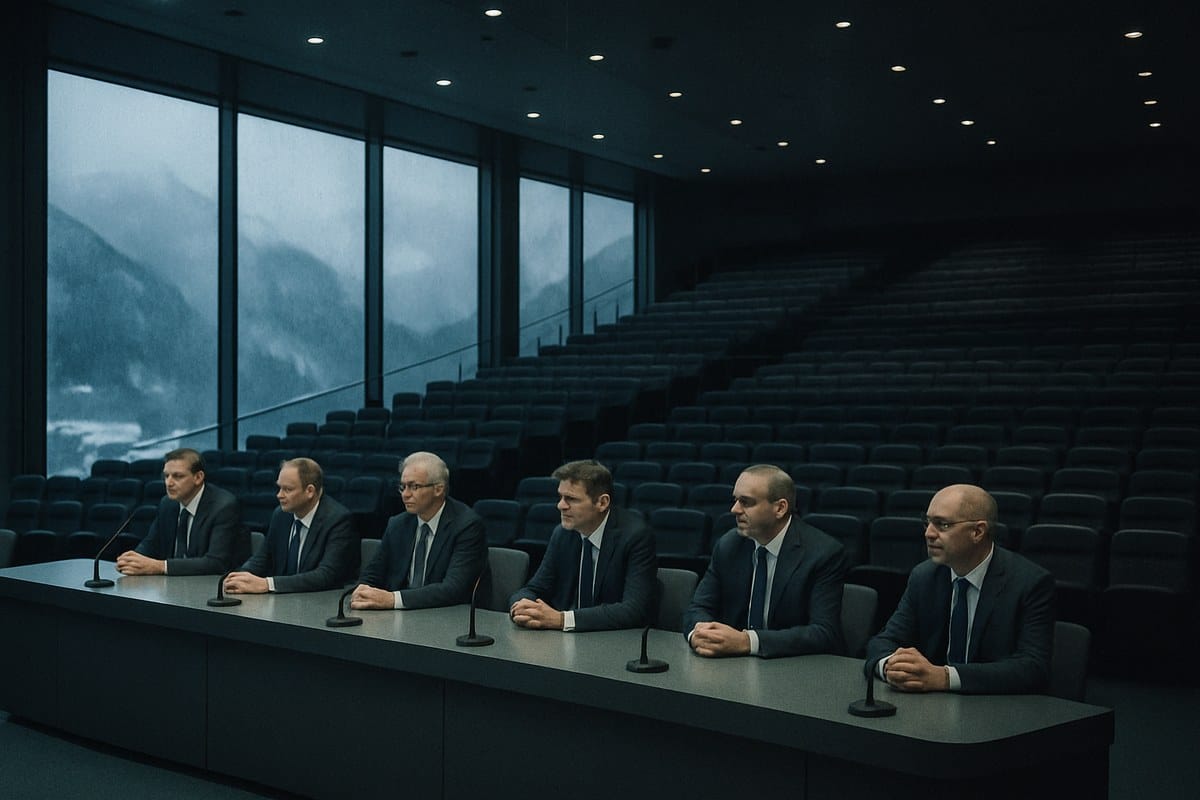
DAVOS, SWITZERLAND — The World Economic Forum’s marquee panel on global AI governance opened Thursday morning with moderator Klaus-Henrik Veld asking a room of 340 billionaires, ministers, and consultants whether anyone had thought to ask the AI itself, at which point three CEOs simultaneously pulled out their phones.
The resulting consensus document, drafted in 11 seconds by an unnamed large language model and lightly edited by a McKinsey associate over an espresso, recommends a light-touch regulatory framework, expanded public-private partnerships, and ‘continued dialogue at next year’s Forum.’
‘We feel the technology has reached an inflection point where serious global guardrails are urgently necessary,’ said one delegate, the chief AI ethics officer for a Gulf sovereign wealth fund, who declined to specify which guardrails or for whom. ‘The important thing is that we are convening. Convening is itself a guardrail.’
The panel, titled ‘Aligning Frontier Models With Human Values: A Roadmap to 2030,’ featured six speakers, four of whom hold board seats at the companies building the frontier models in question. The lone academic on the dais was given seven minutes at the end and used four of them thanking the sponsors.
Attendees described the mood as cautiously optimistic. A senior partner at Beacon Strategy, attending his eleventh Davos, said the AI governance question had matured considerably since last year, when the same panel concluded that AI governance was a question that needed to mature considerably.
By Thursday afternoon, the European Commissioner for Digital Sovereignty had announced a non-binding statement of principles, which a spokesman confirmed was ‘substantially similar’ to last year’s non-binding statement of principles, ‘but with one new bullet about children.’ The bullet was reportedly added at the suggestion of a chatbot.
Outside the Kongresszentrum, a small group of researchers from a Berlin civil-society group attempted to distribute a 40-page report on labor displacement and were politely redirected to a designated free-expression zone behind a snowbank. None of the panelists were available for comment, as they were attending a separate panel on the importance of listening to civil society.
The Forum’s closing communiqué is expected Friday and will, per tradition, urge swift coordinated action by 2027, a deadline that, when reached, will be moved to 2029. Sam Altman is scheduled to deliver Friday’s keynote, in which he is expected to warn that AI poses an existential risk to humanity and also to announce three new products.