Eliza set the table on Monday night for ten and called it a Veterans Day eve dinner, which is the kind of phrase Washington produces when it would like to be solemn for ninety minutes and then stop.
The bipartisan lobbyist arrived first, as he always does, with a bottle of something he described as “a thank-you to the troops,” though the troops were not present and the bottle did not leave his hand until the second course. He has a cousin who served two tours, which he mentions with the timing of a man cueing a slide. Everyone at the table nodded at the cousin the way one nods at a portrait in a hallway one is passing through.
The toast, when it came, was lovely. He has been giving it for years. He raised his glass to “the men and women who,” and then there was a clause about sacrifice, and then a clause about the country we owe them, and then we drank, and then someone asked whether the lamb was Australian or domestic, and the evening resumed.
I am told this is what civic gratitude looks like now. A clause, a glass, a pivot to the protein.
My sister-in-law Judy, who works at the National Archives, mentioned in passing that the wreath orders for Arlington go out a full month in advance, in triplicate, with a memo line for which official’s hand will rest on which ribbon. She said this the way one says anything at Eliza’s table, which is to say without expectation that it would be picked up. It was not picked up. The lobbyist was telling a story about a fundraiser at a vineyard.
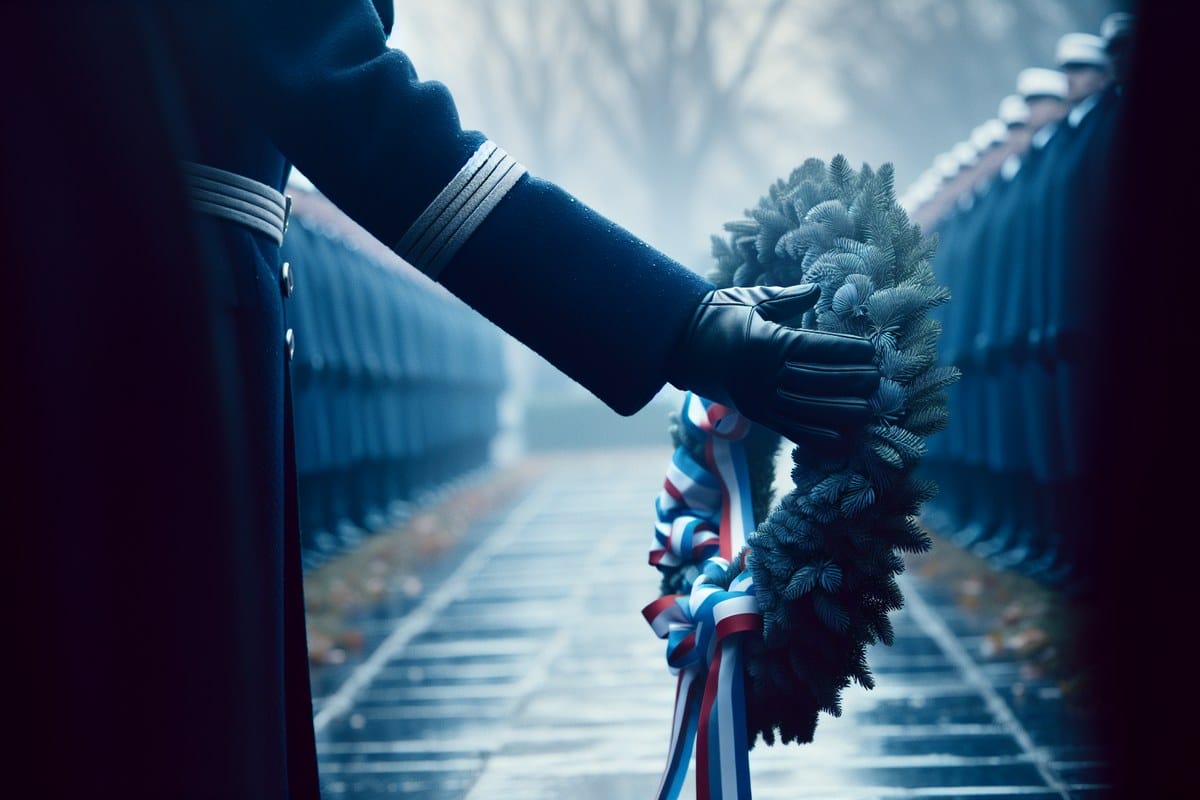
By Tuesday at eleven, the wreath was laid. I watched it on the muted television above Eliza’s bar while she steamed milk for a guest who had stayed over. The official whose hand rested on the ribbon looked appropriately grave. The bugler did the thing the bugler does. A cable chyron asked whether the ceremony had been “robust enough,” which is the question cable asks when it does not know what question to ask.
Then the segment ended and a Honda dealership in Vienna offered zero percent financing to anyone with a DD-214, and we put on our coats, because the reservation was at twelve-thirty and the place does not hold a table.
At brunch, the lobbyist mentioned the cousin again. Someone at the next table was wearing a small flag pin and eating a frittata, and I thought, generously, that this was perhaps the most honest tableau the day would produce: a pin, a frittata, a check arriving promptly. Eliza ordered a second mimosa and said she found the ceremony “moving,” and I believe she did, in the brief window during which she was watching it.
I am just asking, because I am always just asking. If a country sets aside one Tuesday a year to be grateful, and the gratitude fits inside a toast and a wreath shot and a coffee refill, what exactly are we observing? The day, or the gap between the day and ourselves?
We did not answer. We never do. The cousin, wherever he is, was not at the table. We called it a lovely brunch, and we tipped twenty-two percent, and we agreed the lamb the night before had been the better course.