
Home Blog Page 6

Jobs Beat by 35K in February; January’s Beat Quietly Revised Away

0

WASHINGTON, DC — The Bureau of Labor Statistics reported Friday morning that U.S. employers added 198,000 jobs in February, beating consensus by 35,000, while in the same release revising January’s payrolls down by 84,000, erasing a beat that economists had spent six weeks describing as ‘resilient.’

The simultaneous announcement — strong February, retroactively weak January — was greeted on trading floors with the practiced calm of people who have decided this is fine. A bond trader at a midtown desk reportedly looked at the print, looked at his half-eaten chopped cheese, and moved on.

‘What we’re seeing is a healthy labor market that was, in retrospect, slightly less healthy than we claimed it was, but which is now, going forward, healthier than we expect — pending revision,’ said Wendell Pry, chief U.S. economist at Stannard Reach, in a note that arrived at 8:31 a.m. and contradicted his February 1 note in three places.

Economists pointed to unseasonably warm weather in February as the reason the headline beat, which is also the reason January, before revision, was weak. The weather is now considered responsible for both directions.

The two-year yield rose, fell, rose again, and settled within four basis points of where it started — a sequence that took twelve minutes and which CNBC referred to as ‘digesting.’

Buried in Table B-1 was a downward revision to December as well, 22,000 fewer jobs than previously stated, meaning the BLS has now quietly walked back 106,000 jobs across two prior prints while announcing 198,000 in the current one. The net gain of 92,000 was, by professional consensus, not the number to lead with.

Wage growth came in at 0.3% month-over-month, a figure the Federal Reserve will describe next week as ‘consistent with the disinflation process,’ ‘still elevated,’ or ‘in line with expectations,’ depending on which governor is speaking and what time of day.

At BLS headquarters, the office where revisions are processed is reportedly distinguishable from the office where original prints are released only by the carpet, which is slightly grayer. A spokesperson confirmed that the agency stands behind its February data with the same confidence it stood behind its January data exactly thirty days ago.

The March report is scheduled for April 3, at which point the February number is expected to mean something entirely different.
Apple Unveils New iPad For People Who Already Own Two iPads

0

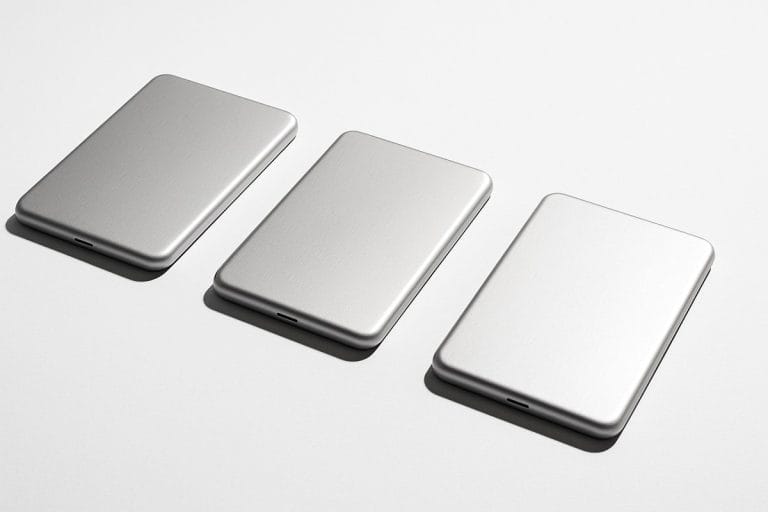
CUPERTINO, CA — In a 47-minute pre-recorded livestream that opened with aerial drone footage of a building most viewers have already seen from a drone, Apple on Thursday introduced the eleventh-generation iPad Air, a device engineered for the rapidly expanding consumer segment of people whose current iPad works fine and whose previous iPad is in a drawer.

The new model, executives said, is 18% thinner, 22% faster, and powered by the M4 chip — sufficient processing headroom, the company noted, to run the four apps the average iPad owner actually opens, which are Safari, Netflix, the Kindle app, and the one where you draw on a photo of your dog.

“This is the iPad we’ve always wanted to make,” said an Apple vice president seated on a stool in what appeared to be a converted aircraft hangar, gesturing at a tablet that resembled, in every observable particular, the previous iPad. “It’s our most ambitious iPad yet, and it’s available in a new color we’re calling Sand.”

Industry analysts framed the launch as a strategic pivot toward the company’s most loyal demographic. “Apple has correctly identified that the people most likely to buy a new iPad are people who already bought an iPad and are therefore the kind of person who buys iPads,” said Marin Cho, a hardware analyst at Beacon Strategy. “They’re not chasing new users. They’re chasing the same user across three product cycles.”

The device’s marquee feature, Apple Intelligence Plus, will summarize emails the user could have read in less time than the summary took to generate, and offers a new “Reword” function that converts polite messages into slightly more polite messages. A demonstration showed the AI rewriting “Thanks!” as “Thank you so much — I really appreciate it!” to audible applause from no one, as the event had no audience.

Also announced was a redesigned Magic Keyboard accessory priced at $299, which now includes a function row, a feature available on every other keyboard manufactured since 1987. The Apple Pencil Pro, sold separately for $129, has been updated with a new haptic engine that simulates the feeling of writing on paper, a sensation available for free at any location with paper.

Reaction among existing iPad owners was muted. “I have one of these,” said Greg Halloran, a Cupertino-area accountant who watched the keynote on his iPad. “I have the one from two years ago. It does everything. I don’t know what I’d do with a thinner one. Hold it more, I guess.”

Environmental commitments featured prominently in the back half of the presentation, with Apple noting that the new iPad’s enclosure is made from 100% recycled aluminum, much of it sourced, the company implied without quite saying, from the previous iPad the consumer is being encouraged to trade in. The trade-in credit, depending on condition, ranges from $80 to $145, or roughly the cost of the pencil.

The new iPad Air will ship March 19, with preorders opening Friday. Apple stock rose 1.4% on the announcement, a movement analysts attributed to investor confidence that consumers will, once again, buy the thing.

The President Spoke Last Night. The Chamber Did the Standing.

0

How many times did you stand last night? I didn’t count, but a man named Robert at Eliza’s table did, and he stopped at forty-one. He said he gave up because the gesture had stopped meaning anything around the fifteenth one, which struck me as the most honest review the evening was going to get.

We had the address on mute in Eliza’s library, the way you keep a fire going in summer — out of habit, and because it’s rude to admit you find the heat oppressive. Eliza poured a Sancerre that her wine man has started describing as ‘unaligned,’ a word I’m told now means ‘we are not telling you whether it is French.’ The bipartisan lobbyist — you know the one — was running his thumb along the stem of his glass and watching the screen with the soft focus of a man who has worked every administration since Reagan and stopped pretending any of them were different.

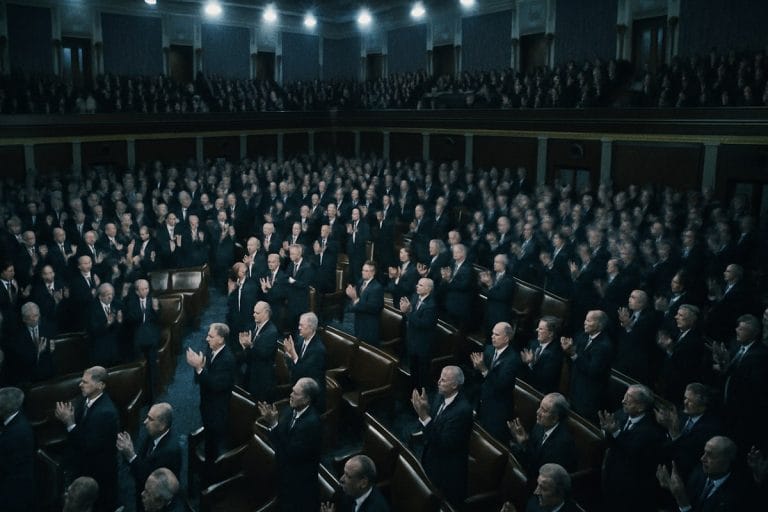
They stood for the tariffs. They stood for the border. They stood for a man in the gallery whose name nobody had been told and whose presence had been arranged at three in the afternoon by a staffer who is, presumably, asleep now. They stood for a sentence about manufacturing that contained no verb. Robert flagged that one — he’d been a speechwriter at State in the nineties — and said the absence of a verb used to disqualify a line, but the chamber had standards now that were more flexible.

There is a particular face that a senator makes during a joint session, and I had forgotten how exact it is. The chin lifts. The mouth holds an expression that is not quite a smile and not quite a grimace — the facial equivalent of a man being audited but trying not to look guilty. The cameras pan and the face adjusts. The chamber knows its blocking. Whatever else you say about the institution, it has, after two and a half centuries, learned where to put its hands.

The lobbyist refilled his glass without standing and said, almost to himself, ‘They’ll do the same thing in January if it’s a Democrat.’ Eliza said, ‘Margaret, please,’ which is what Eliza says when she suspects I am about to say what I am, in fact, about to say. I said it anyway. A chamber that stands forty-one times on a Tuesday does not stop standing because the speaker has changed parties. It stops standing when the seats are empty, which is a different thing, and one we are closer to than people care to admit.

My sister-in-law Judy, who has spent her career at the National Archives and has the unfortunate professional gift of remembering everything, called this morning to remind me that there is a recording of every one of these addresses going back to 1923. She said the early ones are short and the chamber is mostly seated. She said the standing started in the eighties and has been compounding since, the way credit card interest does. Judy is not a satirist by temperament. She does not invent the country she describes. She simply notes that we used to be able to hear the sentences.

What, exactly, is the point of a chamber that performs its enthusiasm on cue? I am asking. The Founders, who were nobody’s idea of restrained men, sat through nearly all of Washington’s addresses — sat, the way you sit through a sermon you are obligated to attend but not obligated to grade. The standing is a recent invention, and like most recent inventions in our politics, it has replaced a slower thing with a faster thing and called the speed an improvement. Robert’s count was, in that sense, a kind of forensics.

At eleven we turned the television off and Eliza brought out the cheese. There was a hard sheep’s milk something I’d never had, and a quince paste the lobbyist pronounced ‘the best thing said tonight,’ a remark he delivered without looking up. Robert had abandoned his count. Judy had gone to bed. The cheese was good. We agreed it was good. We were, briefly, a deliberative body, and we voted unanimously, and we sat down.

Texas Holds Primary, Both Frontrunners Vow to Sue Washington By Wednesday

0

AUSTIN, TX — Texans flooded polling places Tuesday to cast deciding votes in a statewide Republican primary in which every leading candidate had pledged, on camera, to file at least one federal lawsuit against the Biden-era administrative state before sundown Wednesday, regardless of which party currently controls it.

The marquee races for governor, attorney general, lieutenant governor, agriculture commissioner, and railroad commissioner — an office which, per state tradition, has nothing to do with railroads — all featured candidates running to the right of the incumbent, the incumbent, and a small flag printed with the words “DO NOT TREAD.”

“What you’re seeing in Texas tonight is a primary electorate that wants accountability, by which they mean indictments of other people,” said Carla Westin, a polling director at the Lone Star Civic Survey, an Austin outfit that conducts exit interviews in church parking lots. “Every candidate on the ballot has promised to either secede, sue, or, in two cases, both at once. Voters appreciate the range.”

The gubernatorial primary alone produced six candidates, four of whom have at some point referred to themselves as “the only real conservative in this race,” and two of whom are currently subjects of overlapping ethics complaints filed by each other. A seventh candidate, Brad Coyle of Sugar Land, qualified for the ballot in January but has since been described by his own campaign manager as “more of a placeholder, honestly.”

Down-ballot, the attorney general primary featured incumbent Ken Paxton seeking renomination on a platform titled “Eight More Years of This,” while challenger Russ Tilden ran a television ad in which he physically tore up a printout of the Fourteenth Amendment, paused, and tore up a second one in case viewers missed it.

Democrats also held a primary, according to a spokesman who confirmed the matter by email and asked not to be quoted at greater length.

Turnout was reported as “strong in the suburbs and absolutely deranged in the exurbs,” per a precinct chair in Montgomery County who said her polling site had run out of “I Voted” stickers by 9:40 a.m. and begun handing voters small American flags that one elderly man immediately attempted to file as a tax deduction.

Several candidates made campaign stops Tuesday morning at the same Buc-ee’s outside Waco, where lieutenant governor hopeful Dale Brennan staged a press conference in front of the beef jerky wall to announce that, if elected, he would personally fly to Washington and “explain Texas to them, slowly.” Brennan did not specify what he would explain, citing operational security.

The Texas Republican Party, asked whether any of its candidates differed meaningfully on policy, responded with a 14-page document outlining their differences, all of which concerned which federal agency each candidate intended to abolish first. Agriculture Commissioner Sid Miller’s campaign separately clarified that Miller’s pledge to “abolish the weather” had been taken out of context.

By late afternoon, three campaigns had filed pre-emptive lawsuits alleging fraud in counties where polls had not yet closed, and a fourth had filed a lawsuit alleging fraud in the other three lawsuits. A district judge in Travis County declined to rule, citing a long-standing personal policy of waiting until Texans were finished.

Final results were expected sometime Wednesday, at which point the winners will turn their attention to the general election, the legislative session, the special session that follows every legislative session, and a federal courthouse in Amarillo where, per primary-night tradition, a lawsuit will already be waiting on the docket with their name on it.

Supreme Court Asks Voting Rights Act If It Has Any Last Words

0

WASHINGTON, DC — The Supreme Court convened Monday to hear oral arguments in a landmark challenge to the Voting Rights Act, primarily to confirm the statute was still technically alive and to find out whether it had anything it wanted to say before the Court got on with things.

The case, the latest in a thirteen-year project to whittle the 1965 law down to a souvenir, asks whether Section 2 — the part Chief Justice John Roberts has not yet personally signed for — places an undue burden on states by requiring them to not openly cheat. Most observers expect the Court to rule that it does, on grounds the Court has been workshopping since roughly 2008.

Justice Samuel Alito opened questioning by leaning forward, folding his hands, and asking the petitioner’s attorney the single word “Why,” which legal analysts described as the most engaged Alito has appeared during a voting rights case in over a decade.

“He’s clearly invested in the process,” said Tomás Brennan, an elections law fellow at the Hartwell Institute. “Usually he doesn’t even bring the binder. Today he brought the binder. That tells you he’s already written something.”

Justice Clarence Thomas, who has been openly calling for Section 2 to be struck down since the Reagan administration, asked no questions, in keeping with his long-held position that asking questions implies the matter is undecided. He instead spent the morning passing a folded note to Justice Gorsuch, who read it, nodded, and slid it back.

Chief Justice Roberts, the architect of the 2013 Shelby County decision that disabled the law’s preclearance regime by declaring racism had been adequately handled, struck a more measured tone, repeatedly asking the government’s attorney whether Section 2 was “really still necessary, given how nicely everyone has been behaving.” When informed that fourteen states had passed restrictive voting laws within ninety days of his last ruling, Roberts said he wasn’t sure that was responsive.

Outside the building, voting rights advocates gathered on the steps holding signs and chanting, an activity the Court has repeatedly clarified does not appear in its calculus. “We are watching the slow public dismantling of the most important civil rights law in American history,” said Yolanda Reaves of the Southern Coalition for Fair Elections. “And we are watching it be done by six people who keep telling us the patient looks fine.”

Justice Sotomayor’s dissent, expected to run roughly forty pages, is reportedly already drafted, as it has been since November. Justice Kagan was seen mouthing portions of her own dissent during oral argument, occasionally checking a paper copy under the bench.

The ruling is expected in late June, timed to coincide with the start of the midterm redistricting cycle, which Court observers describe as either an extraordinary coincidence or the entire point. Either way, several states have already begun drafting the maps they intend to use once the decision arrives, on the theory that there is no reason to wait for paperwork that has, in a meaningful sense, already been filed.

Iran Held the Runoff Sunday. The Real Vote Was Staying Home.

0

What does it mean when a country holds an election and the citizenry, in numbers too large to spin, simply declines to participate? I have been asking this question all weekend, mostly because I asked it Friday night at Eliza Mortenson’s table and nobody wanted to answer it then either.

Eliza had set the long table in her Georgetown dining room for ten — she always sets for ten, even when six have RSVP’d, on the theory that a chair waiting for someone is a more elegant statement than a chair that wasn’t there. The runoff in Iran was Sunday. We were eating Friday. Already, every wire desk in town knew what the turnout would be, because it had been telegraphed for weeks. The question wasn’t whether Tehran would embarrass itself. The question was who at the table was going to say so.

The bipartisan lobbyist — I will only describe him as bipartisan, because that is the only adjective he has earned over the course of four administrations — was seated to my left, examining the stem of his glass with the kind of attention men give to objects when they are deciding not to speak. He had spent the cocktail hour explaining to Eliza’s nephew that what was happening in Iran was “complicated, structurally.” Structurally is the word men in this town use when they have run out of analysis and would like to keep being paid.

My sister-in-law Judy, who works at the National Archives and has the historian’s habit of making everyone uncomfortable on purpose, said that the regime had stopped publishing precinct-level data three cycles ago, and that the practice of estimating turnout from the parking lots outside mosques was, in her professional opinion, a more reliable methodology than anything the Interior Ministry was prepared to release. Judy said this between bites of the first course. Nobody picked it up.

What I wanted to say — and what I did say, because at a certain age there is no remaining reason not to — was that a runoff election in which the citizenry refuses to show up is not a procedural footnote. It is the loudest thing a population can say while remaining inside the law. The empty booth is a ballot. The unmarked card is a position. The people of Iran on Sunday delivered a verdict on their parliament with the only instrument the regime had left them, which was their absence. The room received this observation the way rooms in Washington always receive observations: by reaching for the bread.

The bipartisan lobbyist eventually offered that of course, of course, low turnout was “concerning,” but that one had to be careful about importing American assumptions about civic participation onto societies with different traditions. I asked him what he thought our own midterm turnout said about our tradition. He said the wine was very good. Eliza said “Margaret, please.” The nephew, to his credit, looked at his plate as if it had betrayed him.

Here is what I keep turning over. We are a country that has spent twenty years lecturing other capitals about the sacredness of the ballot, and we are now well into a stretch where our own most reliable election story is which secretary of state is being sued by which legislature for drawing the maps in the wrong shape. We watch Tehran’s voters refuse the regime’s invitation and we describe it as “complicated, structurally.” We watch our own voters refuse our invitation and we describe it as a turnout problem, as if turnout were weather. Eliza, when pressed, said she preferred not to discuss it at the table. The bipartisan lobbyist agreed. Judy, bless her, asked for the recipe.

The runoff happened Sunday. The boycott happened with it. The dinner happened Friday, and what I will remember about it was not the lamb, which was excellent, but the silence — the long, well-bred, perfectly-set-for-ten silence — of a roomful of people in the capital of a republic who had decided, by unspoken agreement, that the most useful thing to do about an empty polling station six thousand miles away was to compliment the cheese course. We are getting very good at compliments. We are getting worse at everything else.

Three Weeks After Trade Deadline, NBA Playoff Race Looks Suspiciously Like October

0

NEW YORK — A full 22 days after the NBA trade deadline reshuffled rosters, broke up locker rooms, and generated 14,000 thinkpieces about who ‘won the offseason in February,’ league sources confirmed Saturday that the playoff standings are now functionally identical to the ones printed on a placemat at a Buffalo Wild Wings in late October.

The Celtics are first. The Thunder are first. The Nuggets are a problem nobody wants to play. Twelve teams in the West are within four games of each other and all of them are ‘surging,’ according to a graphic ESPN has aired 41 times since Tuesday.

‘We’ve run the numbers and the deadline moved the league’s competitive balance by approximately one-half of one playoff seed,’ said Reggie Donlan, a quantitative analyst at the basketball desk of a midwestern actuarial firm. ‘The Pistons got marginally worse on purpose. The Wizards got marginally worse by accident. Everyone else is exactly where they were when Joel Embiid first said his knee felt weird.’

The lone confirmed casualty of deadline week was a 6’9″ forward who was traded three times in 48 hours and reportedly spent Tuesday morning in a Marriott lobby in Charlotte trying to figure out which team’s group chat to rejoin. He has since been waived, signed, waived again, and is currently averaging 11 and 6 in Lithuania.

Contenders who ‘made bold moves’ to ‘go all in’ include the Lakers, who acquired a 34-year-old combo guard with a bone spur, and the Knicks, who traded four second-round picks for the right to keep paying a player they already had. Both teams remain the fourth and fifth seeds, respectively, exactly as they were in November, December, and the week before LeBron’s last cryptic tweet.

The Sacramento Kings, briefly mentioned in 38 trade rumors, did nothing, said nothing, and now sit one game out of the play-in, which a team spokesperson described as ‘our ceiling, our floor, and our brand.’

Down at the bottom, the league’s six designated tank teams are locked in a fascinating race to lose more compellingly than the others. The Wizards lead by half a game. The Hornets are ‘finding their identity,’ per coach Charles Lee, who declined to specify what that identity is or when fans might see it. Brooklyn has now lost 11 in a row, which the Nets front office is counting as a successful execution of strategy.

‘People keep asking what the deadline accomplished,’ said one Eastern Conference assistant GM, speaking on the condition that nobody quote him by name because his roster contains no players anyone would recognize. ‘It accomplished forty-seven podcasts. It accomplished a Shams tweet at 2:47 a.m. that genuinely woke up my wife. The standings, no. The standings are vibes.’

The league’s marquee post-deadline matchup — a Saturday night Celtics-Nuggets game ESPN is billing as ‘The First True Test of the New-Look Contenders’ — features zero players who were traded in February and is expected to end, per Vegas, with Boston winning by 7.

SAG Awards Open With 47 Actors Solemnly Confirming They Are Actors

0

LOS ANGELES, CA — The 32nd Screen Actors Guild Awards opened Friday night with the union’s traditional cold open, in which 47 working performers stared directly into the camera one at a time and confirmed, with the gravity of a hostage proof-of-life video, that they are an actor.

The segment, which ran nine minutes and forty seconds, included three sitcom leads, a Marvel sixth-billed, two people from the British prestige show your aunt won’t shut up about, and a man best known for playing a corpse in two separate procedurals. Each one delivered the line as if breaking news.

Inside the Shrine Auditorium, the ceremony then proceeded to hand small bronze statuettes of a naked man to other naked men, in front of a room of formally dressed people who applauded as if they had not been expecting this.

“The SAG Awards are unique because they’re voted on by actors, presented to actors, and watched, statistically, by no one,” said Renata Pell, a credentialed entertainment-industry observer who runs a Substack about award shows nobody asked for. “That’s what gives them their integrity.”

Winners delivered acceptance speeches that thanked, in order: the cast (“my family”), the crew (“the real heroes”), their agent (“a warrior”), their manager (“another warrior”), their publicist (“my third warrior”), and a person identified only as “Mom, you were right.” Two winners cried. One winner cried at another winner crying.

The Best Ensemble category, traditionally the night’s biggest award, went to a streaming drama that 11 percent of Americans have heard of and 1.4 percent have finished. The cast took the stage as a group of nineteen, each of whom was handed a microphone, and each of whom used it.

A presenter introduced the In Memoriam segment by reminding the audience that acting is, at its core, the act of being remembered, which several actors in the front row appeared to write down. The montage included a brief, unexplained cutaway to a man waving from a porch who was, according to producers later, not actually deceased.

Backstage, a craft services worker stocking the press room said the green room had run out of the small water bottles by 5:40 p.m. and was now exclusively offering “the medium ones, which nobody wants.” She declined to give her name, citing a non-disclosure agreement she signed for reasons she could not recall.

The ceremony closed, as it does every year, with the cast of a long-canceled ensemble drama reuniting on stage for a tribute nobody requested, during which one member appeared visibly surprised the others were still alive. Ratings are expected to be down again, which the Guild called “a vote of confidence in the work.”

Kansas Pulled the Licenses Tuesday. The Brisket Was Excellent.

0

What does a state do when it has run out of useful problems to solve? It invents one, of course, and on Tuesday the Kansas Legislature invented a beauty. It voted to suspend the driver’s licenses of every transgender resident in the state. Not restrict. Not flag. Suspend. As of this writing, several thousand Kansans are legally forbidden from driving to work, to the pharmacy, or to their mother’s house in Hutchinson, because the state has decided their licenses are now philosophical documents rather than practical ones.

I read the news Tuesday afternoon and then I went to dinner.

The dinner was at Eliza’s, in that yellow house off Wisconsin she and Charles have been renovating since the second Obama term. There were eight of us. Eliza had made a brisket, which she does when she suspects the conversation will need ballast, and she had warned me on the phone that one of the other guests was a bipartisan lobbyist — her word, bipartisan, which in this town means a man who will not tell you what he believes because he has not yet been paid to believe it.

I brought up Kansas over the salad course. I am told this is a thing one is not supposed to do anymore at dinner, the way one was not supposed to discuss the Pentagon Papers in 1971, or the savings-and-loan business in 1989, or any number of other things one was eventually quite glad somebody discussed.

The bipartisan lobbyist examined his cufflink. Charles asked who wanted more wine. A woman whose name I did not catch — she does something at State, I gathered, the way other people do something with horses — said the word “federalism” with the calm authority of someone reading it off an index card. Eliza put her hand on my forearm and said, “Margaret, please.” She has been saying “Margaret, please” to me at her dinners since the first Clinton administration, and the meaning has not appreciably changed.

My sister-in-law Judy, who works at the National Archives and who has therefore developed a professional immunity to euphemism, was not at the dinner, but I called her on the way home. She said the thing I knew she would say, which is that they used to call this kind of measure a “civil disability,” and that the phrase had gone out of use sometime after Reconstruction because it had become embarrassing. “Now they just don’t name it,” she said. “That’s the upgrade.”

I want to be careful here, because I am told I am shrill when I am not careful. So let me be precise. A driver’s license, in most of the United States and certainly in Kansas, is not a luxury. It is the document that lets you exist as an adult — to cash a check, to buy cold medicine, to be pulled over and let go. Suspending it is not symbolic. It is the state telling a category of people that their daily errands are now a favor the state may, at its discretion, withdraw.

The conversation at Eliza’s eventually moved, as conversations there always do, to the renovation. The contractors had found something behind the dining-room wall. Original wainscoting, beautifully preserved. Everyone agreed it should be saved. There was real feeling in the room about the wainscoting. There was unanimous consent.

I am, as my readers know, just asking questions. I am asking what kind of country issues a press release on a Tuesday afternoon stripping several thousand of its own citizens of the right to drive themselves to the dentist, and then expects the rest of us to consider it one item among many in a busy news cycle. I am asking which guest at the table is going to say something the next time, and which guest is going to ask for more wine, and whether those are going to turn out to have been the same guest all along.

The brisket, for what it’s worth, was excellent. Eliza used her mother’s recipe. We all asked for it on the way out.

Nvidia Beats Q4 by 12%, Misses Whisper Number Invented at 9:47 AM

0

SANTA CLARA, CA — Nvidia reported fourth-quarter revenue of $42.1 billion Wednesday afternoon, topping consensus estimates by roughly twelve percent and falling well short of the whisper number a Goldman desk analyst coined on a Slack channel at 9:47 a.m. the same morning, sending shares down 3.4% in after-hours trading on what one trading floor described as “vibes-based disappointment.”

The chipmaker posted record data center revenue of $35.8 billion, record gross margins of 75.1%, and record everything else the company is permitted to measure, none of which mattered because the buy-side had spent the previous forty-eight hours convincing itself the actual print would be $44 billion, a number Nvidia had at no point suggested, implied, or hallucinated.

“The beat was technically a beat, but it wasn’t the beat-beat,” explained Priya Wendell, a semiconductor analyst at Harborline Equity Research, eating what appeared to be a cold halal cart lunch at her desk. “There’s the consensus number, there’s the buy-side number, there’s the whisper number, and then there’s the number Jensen needed to print to justify the multiple. He hit three of four. The market is a perfectionist.”

CEO Jensen Huang, wearing the leather jacket, told analysts on the call that demand for Blackwell chips remained “insane” and that the company was “sold out through 2027,” phrasing Nvidia has now used in eleven consecutive earnings calls without anyone asking what happens in 2028.

Roughly 53% of the quarter’s revenue came from four customers Nvidia is not legally required to name but which everyone on the call referred to as “the hyperscalers,” a word that has quietly replaced “diversified customer base” in the company’s investor deck without anyone updating the risk factors.

One portfolio manager at a long-only fund in Boston, reached by phone while attempting to reset his Bloomberg password for the third time, said the print was “objectively excellent and subjectively a catastrophe,” adding that he would be on CNBC in the morning calling it a buying opportunity regardless of where the stock opened.

Guidance for Q1 came in at $44 billion, also a record, also a beat, and also not enough, with several analysts pointing out that the company had only raised guidance by $2 billion instead of the $3 billion implied by Microsoft’s last capex commentary, an Azure tea-leaf reading that has now graduated from sell-side research into actual valuation models.

The stock’s after-hours decline briefly erased $94 billion in market capitalization, an amount roughly equivalent to the entire enterprise value of Intel, which mentioned this on its own corporate X account before deleting the post eleven minutes later.

Nvidia’s report came hours after the Federal Reserve released the minutes from its January FOMC meeting, in which officials used the word “patient” fourteen times and the word “vigilant” eleven times, a ratio Bloomberg’s NLP desk flagged as marginally more dovish than December, news that moved markets for approximately ninety seconds before everyone remembered Nvidia was reporting.

By the closing bell Thursday, the stock is expected to recover, decline further, or do both within the same forty-minute window, at which point a different analyst at a different firm will publish a note explaining that the real number to watch was never revenue at all, but something called “sovereign AI bookings,” a line item that did not exist eighteen months ago and now apparently underpins the entire S&P 500.