Home Blog Page 31

A Single Sparkler Burns 14 Grams of Barium and Garrett Just Bought 144 of Them at Sam’s

0

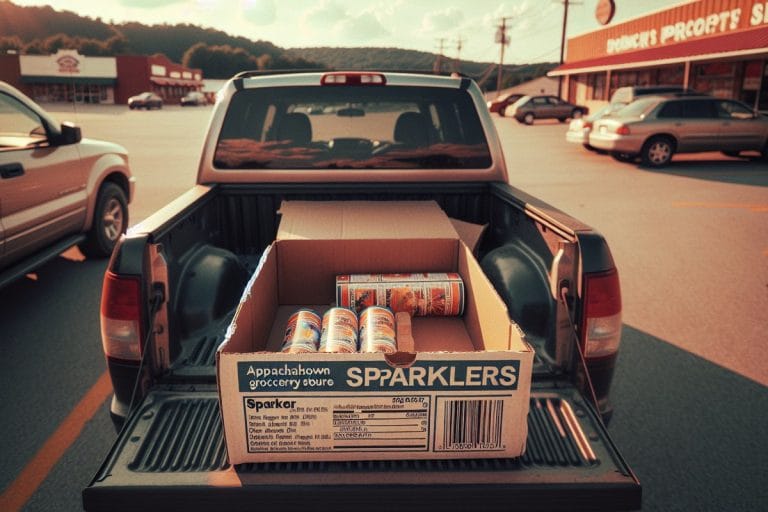
I am writing this from the front seat of the Tahoe in the Ingles parking lot because Garrett has already loaded a flat of sparklers into the cargo area and I cannot, in good conscience, drive these home without first reading the side of the box, which I did, and which is the reason my hands are shaking on the steering wheel and Ember is asking why I keep saying the word strontium.

One sparkler. One. Is approximately fourteen grams of barium nitrate, aluminum powder, iron filings, and a dextrin binder that the box describes only as “binder,” which is the word people use when they do not want you to ask the next question. Garrett bought a hundred and forty-four. We have four children. Do the math with me in the parking lot. That is thirty-six metallic-fuel rockets per child, held at face level, on Friday, in our driveway, voluntarily, while a neighbor films it for the grandparents.

I do not want to be the woman in the cul-de-sac with the clipboard. I have been her before. I will be her again. But the Facebook group I trust most on this — it is called Sparklers Are Just Tiny Smelters and Nobody Will Say It, and the moderator is a former pyrotechnician from a county fair in Ohio who left the industry over what she saw — has been pinning the same SDS sheet for two weeks straight, and the SDS sheet uses the phrase “do not inhale fumes” four separate times in a product designed to be waved one foot from a child’s open, laughing mouth.

My sister-in-law Renee, who works the front desk at the pediatric office in Black Mountain and is basically a nurse, said barium is what they make you drink before a GI scan and that is the controlled medical version, in a cup, with a doctor present, and we are about to aerosolize it over a kiddie pool while Garrett’s brother plays Toby Keith on a Bluetooth speaker shaped like a football.

And listen — I am not anti-sparkler. The sparkler my grandfather lit in his driveway in 1962 was, by every account I have been able to gather from his sister Marlene before she passed, essentially iron filings, a little potassium, and pride. That sparkler smelled like a barn. That sparkler put off the kind of smoke a man could stand in. The modern sparkler smells, and I will die on this, like the inside of a hair dryer that has been left on a beach towel.

Garrett’s response when I showed him the ingredient panel was to forward me a newsletter from his old high school baseball coach — the coach has a Substack now, which is its own conversation — arguing that “the kids will be fine” because “we all did this and we turned out okay,” and I would gently point out that Coach Bowden is currently writing a Substack from a recliner about how aluminum bats ruined America, so the bar for “turned out okay” has shifted considerably since 1978.

I made some calls. The hand-dipped beeswax tapers I was hoping to substitute have a six-week lead time from the woman in Weaverville who does them, which is what happens when you try to source a holiday ethically two days out. The LED “safe sparkler” from Target contains a button battery, and a button battery is, in my opinion, just a sparkler that has learned patience. The clean option, the woman in the Telegram channel told me — and I screenshotted this so I have it — is a single lit sage bundle held by an adult while the children watch from the porch, which is, and I want to be honest with you, not going to play with my father-in-law.

So here is the plan, and I am workshopping it. Each child gets one (1) sparkler, lit by me, held downwind, over the gravel, for the duration of “God Bless America” only, after which it goes directly into a galvanized bucket of well water that I will then dispose of at the transfer station, not in our garden, because the soil around our blueberries has been through enough this year between the mulch incident and what the Lowe’s flag did to the garage.

The remaining one hundred and forty sparklers Garrett bought are going back to Sam’s Club on Saturday, in the original flat, with the receipt, and I will be the one returning them, because Garrett has “a relationship” with the manager and I do not, which means I am the only person in this household capable of looking a stranger in the eye and saying the word barium out loud.


Baby Oil Sales Drop 71% in 24 Hours as America Suddenly Claims to Have Never Heard of It

NEW YORK — Within ninety minutes of the federal verdict reading on Wednesday, U.S. drugstore sales of baby oil had collapsed 71% nationwide, a figure analysts attribute to roughly 184 million Americans simultaneously walking into their bathrooms, looking the bottle in the eye, and asking it what, exactly, it thought it was doing there.

The crash — the steepest single-day decline ever recorded in the personal emollients category — followed Sean “Diddy” Combs’s conviction on two counts of transportation for prostitution, a verdict that managed to recode a previously neutral 18 inches of pharmacy shelf as the most shame-saturated retail space in the continental United States. By 4 p.m. Eastern, the word “baby” and the word “oil” could not be said within six feet of one another in any CVS in the tri-state area without a cashier averting their eyes.

“Last Thursday a guy bought four bottles and a blue Gatorade and I didn’t think a single thing about it,” said Marcos Pellicer, a night manager at a Walgreens in Hoboken. “Tonight a woman picked one up, made eye contact with me, put it back, and bought a NIV Study Bible. She didn’t even need a Bible. I could see the one in her purse.”

Within hours, the fallout had spread well beyond the aisle. Johnson & Johnson is reportedly fast-tracking a rebrand under the working name “Sun & Sea Botanical Hydration Complex,” with a planned bottle redesign that removes the word “baby,” the word “oil,” and the color yellow. Etsy listings for “ironic baby oil candle, gag gift, you know the one” cleared 9,400 by dinner and were quietly delisted by 9 p.m. when sellers realized no one wanted the joke in their house either.

Affected demographics are scrambling. Wedding photographers, competitive bodybuilders, NICU nurses, and the parents of approximately every infant born after April have all been forced to deliver unsolicited explanations at the checkout, often beginning with the phrase “this is genuinely for —” before trailing off into a hand gesture. A Long Island bodybuilder identified only as Trevor reportedly attempted to purchase six bottles for a regional Mr. Suffolk County qualifier and was instead asked by the cashier if he wanted to “talk about it.”

Costco locations in seven states have voluntarily roped off their 55-gallon commercial drums of mineral oil with a single strand of yellow caution tape and a hand-lettered sign reading “FOR PROFESSIONAL USE,” though no employee can explain what profession qualifies. A Sam’s Club in Tulsa simply pushed the pallet behind a stack of patio umbrellas and is pretending it isn’t there.

The return desks are also overwhelmed. A Target in Bergen County logged 312 unopened-baby-oil returns between 6 a.m. and noon, the majority offered with the explanation “I don’t actually know how this got in my cart” and one notable instance of a man simply pushing the bottle across the counter and walking away without speaking. Store policy now permits associates to issue store credit without a receipt provided the customer maintains uninterrupted eye contact.

Industry forecasters suggest the category may stabilize once consumers find a socially acceptable replacement, though early indicators are not promising: searches for “baby oil alternative for legitimate reasons” surged 4,000% on Wednesday, with the top result being a Reddit thread from 2017 in which the only reply was the word “why.”

As of press time, a single bottle of Johnson’s Original remained on a shelf at a Duane Reade in Midtown, where it had been pushed to the very back by a series of customers using only one finger, like it was a spider they did not want to commit to killing.

Third Interstellar Comet Ever Detected Arrives, Looks Around, Politely Leaves

0

PASADENA, CA — Astronomers confirmed Tuesday that a fast-moving comet cutting through the inner solar system originated from somewhere outside it, making 3I/Atlas the third interstellar object ever detected and, according to its trajectory, the third to want absolutely nothing to do with us.

The object, first flagged by an automated sky-survey in northern Chile, is traveling at roughly 60 kilometers per second along a path so steeply unbound from the Sun’s gravity that researchers say it will exit the solar system and not be observable again for, conservatively, the rest of human civilization.

“It came from another star, it is passing through, and it is leaving,” said Dr. Aldo Berenger, a planetary astronomer with the Mount Wilson observing consortium. “We have had about a week to look at it. It does not appear interested in a longer engagement.”

Spectroscopic analysis suggests 3I/Atlas is a fairly ordinary comet — a chunk of frozen volatiles and dust likely shed from a planetary system several light-years away — though Berenger noted that “ordinary, in this case, means it was hurled across the galaxy for several billion years before arriving at exactly the moment we are this.”

Within hours of the announcement, social media users had begun proposing alternate names, lobbying the International Astronomical Union to formally designate the object “Cometn’t,” “the One That Got Away,” and, in one widely circulated post, “Honestly, Same.” A Change.org petition asking the IAU to rename it “First Smart Visitor” had gathered 41,000 signatures by Tuesday afternoon.

Climate researchers, meanwhile, noted that 3I/Atlas’s brief flyby coincides with the start of Atlantic hurricane season, an active heat dome over the Midwest, and the fourth consecutive week in which the planet’s surface temperature has exceeded what one modeling team described as the “we should probably stop making graphs about this” threshold. A NOAA spokesperson declined to draw any connection between the two phenomena, on the grounds that the comet has nothing to do with anything and “frankly seems to have the right idea.”

3I/Atlas will reach perihelion in late October before being slingshot back into interstellar space at a velocity that, researchers emphasize, will not be sufficient to bring it back. Berenger, asked whether any instrument could be deployed in time to gather more data, said the team was working on it but had begun to make peace with what he called “the dignity of its exit.”

The comet will remain visible to amateur astronomers with mid-range telescopes through August, after which it will dim, recede, and, as one Caltech graduate student put it, “become the only thing in recent memory to make a clean getaway.”

SaaS Tool Will Quietly De-Rainbow 2,400 Corporate Logos at Midnight

0

SAN FRANCISCO — At 11:59 p.m. Pacific tonight, a Series B startup called HueShift will execute the single largest scheduled commit in its 47-month history, automatically reverting the logos of 2,400 enterprise clients from rainbow gradient back to their standard brand palette, a synchronized retraction the company estimates will take 11 minutes and require no human approval at any stage.

HueShift, founded in 2021 on the pitch-deck thesis that ‘Pride Month is fundamentally a logistics problem,’ charges enterprise customers between $38,000 and $112,000 per year for software that programmatically applies and removes thematic overlays across an organization’s logo, app icons, email signatures, in-store signage, and the avatars of regional VPs who have not logged into LinkedIn since 2022.

‘The thing nobody understood before us was that allyship at scale is a deployment pipeline,’ said Reese Tannenbaum, HueShift’s VP of Product, in a launch-week interview the company’s PR firm asked be republished today. ‘A Fortune 500 has 14,000 customer-facing assets. You can’t have an intern in Frankfurt opening Photoshop on June 1.’

The platform’s most-licensed feature, internally referred to as ‘Geofenced Affirmation,’ allows customers to display the rainbow logo on the U.S. and Western European versions of their websites while serving the standard logo to visitors in Russia, Hungary, the UAE, and, since a January update, six American states whose attorneys general have sent letters. A spokesperson clarified that the feature is ‘about respecting local context’ and is ‘not on the marketing site for unrelated reasons.’

Tonight’s reversion will be aided by a module HueShift quietly rolled out in February called Sunset Mode, which scrubs not only the rainbow overlay but any DEI-adjacent landing-page copy a client flagged in the spring as ‘reviewable,’ replacing it with pre-approved fallback language about ‘building belonging through performance excellence.’ The module is bundled into the standard enterprise tier and was, according to two product managers, the company’s fastest-adopted release ever.

HueShift declined to name specific customers but confirmed that its client roster includes seven of the ten largest U.S. banks, four major airlines, two oil majors that maintain rainbow logos exclusively on their human-resources subdomains, and a defense contractor whose June avatar features a rainbow gradient subtly incorporating the silhouette of a guided munition.

Marcus Hadley, who runs a 14-person LGBTQ advocacy nonprofit in Oakland that has spent the month trying to get any of the company’s clients to return a phone call about actual policy commitments, said the automation is, in some ways, clarifying. ‘For years we wondered if anyone behind these logos cared,’ Hadley said. ‘It turns out the answer is that a Python script cares, on a schedule, between approximately May 28 and June 30, in territories where caring is legal.’

HueShift’s roadmap, viewed by this reporter, lists upcoming modules for Hispanic Heritage Month, Breast Cancer Awareness October, Veterans Day, and a beta product called Crisis Solidarity, which would auto-apply national flags to corporate avatars within 90 minutes of a qualifying geopolitical event, configurable by region and by ‘reputational exposure score.’

Tannenbaum said the company expects revenue growth of 60 percent next year, driven primarily by clients seeking what HueShift’s marketing now calls ‘values agility’ — the ability, he explained, to express a commitment one month, retract it the next, and never have to remember which one they were currently doing.

Three Sturgeon Bay, WI Residents Have Ordered Custom Sashes Believing Each Is Friday’s July 4 Parade Grand Marshal

0

STURGEON BAY, WI — Three Door County residents have walked into Stitch & Co. on N 3rd Avenue in the past nine days and ordered custom red-and-white sashes reading GRAND MARSHAL — JULY 4, 2025, each operating under the unshakable impression that he or she is, alone, the Grand Marshal of Friday’s parade. Mayor Doug Halverson confirmed Sunday afternoon that this is, in his words, "a thing we are working through."

According to Halverson, the position was promised in three separate conversations — at the Memorial Day brat fry, immediately following a zoning hearing on June 4, and once "in the produce aisle at Econofoods" — none of which were attended by a person taking notes, including Halverson himself.

Joline Pavlicek, who has run Stitch & Co. for nineteen years, said she suspected something was off when the second customer placed an identical order. "I asked her if she knew about the first one," Pavlicek said. "She said there was no first one. Then the third one came in. I stopped asking."

The three sashed residents — retired letter carrier Carl Vrieze, fifth-generation cherry farmer Pat Lutz, and Cherry Festival board chair Linda Brask — have not, as of Sunday evening, been informed of one another. Each has independently begun practicing a wave.

Parade committee chair Wanda Heisler said the committee learned of the overlap Friday night and held an emergency meeting Saturday morning that produced, by her account, "no resolution and one nosebleed." A motion to split the parade into three slightly staggered processions was tabled without a second.

The situation deepened Saturday afternoon when Ernie Behnke, 81, arrived at the city clerk’s office holding a Door County Co-op napkin dated July 2003, on which, he says, then-Mayor Wessel promised him the role "next time it comes around." The napkin reads GRAND MARSHAL — ERNIE in what city staff have provisionally identified as ketchup.

Halverson, reached Sunday outside the Methodist church, said he was "letting it cook" and expected to have an update by Tuesday, possibly Wednesday. He declined to say which of the three he intended to inform first, citing what he called "the order in which I run into them at the gas station."

Pavlicek, for her part, was finishing the third sash. "It’s already paid for," she said, threading the loop on Brask’s. "I don’t get paid to figure out who’s the Grand Marshal. I get paid to make a sash."

The Court Demoted Birthright Citizenship to a Filing Question

0

When, exactly, did we decide that the Fourteenth Amendment was a venue dispute? Because that is what the Supreme Court told us on Friday, in the polite, vowel-rich prose that institutions reserve for the afternoons they remove a load-bearing wall.

The ruling, if you read past the press releases, said that lower courts can no longer issue the universal injunctions that have been pausing the administration’s birthright citizenship order. In thirty days, the executive branch may begin enforcing the order against everyone who wasn’t personally named in a lawsuit. Which means a child born in Houston and a child born in San Antonio may now arrive into two different countries, depending on whether their parents had the foresight, the lawyer, and the standing.

I was at Eliza’s that night, in Kalorama, where the windows were open because the heat had finally broken and someone had brought a lamb. The conversation began, as conversations have begun all month, with the weather, then the Mets, then a brief, theatrical sigh about the price of strawberries. Then somebody — I think it was Judy, my sister-in-law, who has spent the last decade at the National Archives and has earned the right to interrupt — said the word “Friday,” and the room rerouted around it the way traffic reroutes around a downed tree.

The bipartisan lobbyist was there. I will not name him because he prefers not to be named, which is itself a kind of profession now. He examined his cufflink and said the ruling was “actually a quite narrow procedural decision.” Eliza said “Margaret, please,” before I had said anything, which I took as a compliment. Judy said the Archives had been quietly digitizing the original citizenship clause case files for nearly two years, and that not one reporter had ever asked her why.

I asked the lobbyist who, in his estimation, would be affected. He said the question was “interesting.” Interesting is the word a bipartisan lobbyist uses when he means he would prefer to discuss the lamb. The lamb, for the record, was excellent. The mint was from Eliza’s roof. There was unanimous consent on the mint.

By Saturday morning the op-ed pages had settled on their framing, which was that the Court had wisely curtailed the overreach of district judges. Judicial restraint, they called it — a phrase that, like “adult in the room” and “return to normalcy,” now means whatever the speaker needs it to mean before brunch. Nobody was writing about the children. The children had been filed under standing.

This is what an institution looks like when it decides to lose its nerve in installments. Not a great thunderclap, not a televised crisis. A procedural ruling on the last Friday of the term, released at an hour calibrated for the second wave of the news cycle, in which the most consequential clause in the document is converted into a question about who gets to sue on behalf of whom. The Fourteenth Amendment, after Friday, does not apply nationally. It applies in the courtrooms where someone managed to get a hearing.

I asked Judy, on the way to the kitchen, what she thought we would tell people about this in twenty years. She said the Archives don’t tell people anything. They just keep the files. She said the files are very good at waiting.

The lobbyist left early, citing a flight. Eliza brought out a cheese I had never heard of, and the bipartisan husband of a woman I will not name said the Court had merely “clarified the tools.” Somebody laughed. Somebody refilled a glass. Outside, the city was the temperature of a country that no longer asks itself whether its children are its children, or whether that is now a matter for the regional courts.

We passed the lamb. We praised the mint. We asked Eliza for the recipe, and she wrote it on the back of an envelope, and we put it in our bags, and we went home through the warm streets of a republic that has begun, very quietly, to operate by jurisdiction.

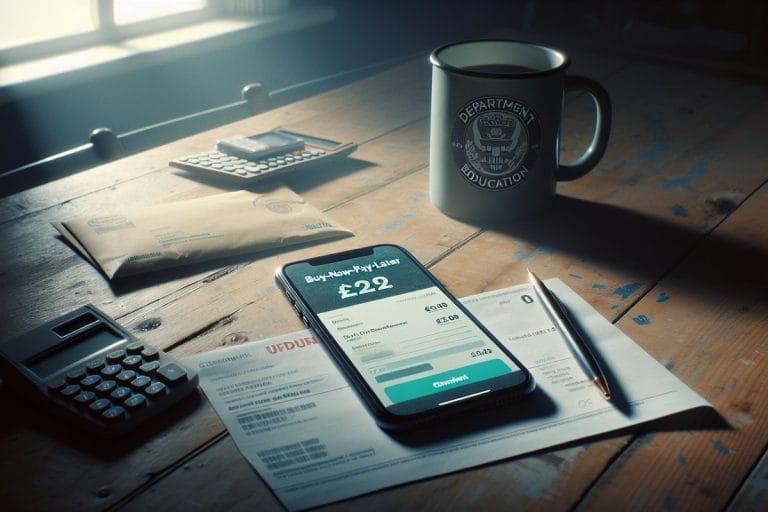
Klarna Will Now Loan You the Money to Make Your Student Loan Payment

0

STOCKHOLM — Klarna, the Swedish buy-now-pay-later giant whose business model rests on the belief that any purchase under $300 should be split into four installments spaced just far enough apart to forget the first three, announced Friday it will begin financing federal student loan payments for American borrowers, allowing customers to take out a small short-term loan in order to make a payment on a much larger long-term loan.

The product, branded Klarna Studi, launches in 38 states next week, timed to the official end of the SAVE plan and the resumption of interest accrual for roughly 8 million borrowers, many of whom are receiving their first real bill in five years and reacting to it the way a deer reacts to a Subaru. “Borrowers told us they wanted more options,” the company’s press release read, before listing one option.

An internal pricing sheet reviewed by mmnn shows the Klarna Studi loan carries a flat $4.99 service fee, a 29.99% APR if not repaid in 30 days, and an automatic enrollment in a $7-per-month “financial wellness” subscription that, among other things, sends users a weekly email reminding them they are in debt.

A 31-year-old paralegal in Cleveland who agreed to discuss the product on the condition that her servicer not find out said she had recently used Klarna to finance an $84 anniversary dinner, a $612 student loan payment, and the late fee on the previous Klarna loan. Asked which of the three she was furthest behind on, she paused for what she described as “a long time.”

Renata Boczek, a senior consumer credit researcher at the Atlantic Heartland Project, called the rollout “the first publicly disclosed instance of a federal student loan servicer and a buy-now-pay-later platform being legally permitted to debit the same checking account on the same Tuesday for two separate payments toward the same underlying loan.” She added that the structure was, technically, “not illegal in 41 states.”

Klarna’s American CEO defended the product in a LinkedIn post that used the phrase “democratizing access to debt service” twice and the word “runway” once. He noted that 73% of Studi’s pilot users had reported feeling “more in control of their finances,” a statistic the company arrived at by surveying users immediately after their first payment cleared and before the second one came due.

The Department of Education declined to comment on whether the arrangement violated any provision of its servicer contracts, citing the fact that no one currently working at the Department of Education had been there long enough to know what the servicer contracts said. A spokesperson confirmed the agency was “monitoring the situation,” which she clarified meant a single staff attorney had bookmarked Klarna’s homepage.

Reaction on TikTok was muted. A finance creator with 412,000 followers posted a 14-second video describing Studi as “just another bill that becomes a different bill,” then disclosed in the caption that the video was sponsored by Klarna. Top comment, with 38,000 likes: “this is fine.”

Affirm is reportedly developing a competing product that will finance only the interest portion of a federal student loan payment, on the theory that this represents a more disciplined approach to lending. Industry analysts expect the offering to launch in time for the holiday shopping season, when American consumers will once again be asked to split a $42 sweater into four payments of $11.

It Hit 103 on Tuesday. The Word ‘Climate’ Did Not.

0

When did we agree, as a city, that weather was a small-talk topic and not a policy one? I ask because on Tuesday it was 103 degrees in Washington, and at Eliza’s table that night, in a dining room where the central air was making a noise I have not heard a central air make before, we discussed the mango sorbet at considerable length and the planet not at all.

The sorbet was excellent. I want to say that. Eliza had done something with cardamom. The bipartisan lobbyist — you know the one, I will not name him, he sits on three boards and a fourth he prefers I not mention — complimented the texture twice and examined his cufflink between compliments. He has a tell, that cufflink. It comes out when a subject he would rather not address is approaching the table at speed.

The subject did not, in the end, arrive. We talked about the Outer Banks. We talked about whether the Whitfields were doing the lake again this year. We talked about a Senate staffer’s wedding in Charleston in August, which someone called “brave,” and everyone laughed, and nobody followed the laugh anywhere it might have led.

The District, for its part, had issued what it called a “Heat Emergency Cooling Advisory,” a phrase constructed entirely so that no single word in it would have to do any work. Cooling centers were opened. Buses were free after 4 p.m. A press release went out from somewhere on the Hill containing the word “resilience” three times and the word “emissions” zero. I counted. This is what I do now at dinner parties. I count.

My sister-in-law Judy, who has worked at the National Archives for twenty-six years and has opinions about humidity that would shame a climatologist, told me they sent everyone home Tuesday at one o’clock. They called it “weather leave.” Judy said the word “weather” the way a hostage reads a statement. The HVAC in the stacks, she said, is not designed for a 103-degree June, because nobody designing an HVAC system in 1994 was designing for a 103-degree June, because in 1994 a 103-degree June in Washington was the kind of thing you put in a novel to indicate the end of a civilization.

I mentioned this at the table. I said the word “1994” and the word “civilization” in the same sentence, which I will admit is a Margaret Thorne move, and Eliza said, very gently, “Margaret, please,” the way she says it when she would like the conversation to go back to where it was, which was the sorbet.

So the conversation went back to the sorbet. The bipartisan lobbyist said something diplomatic about the cardamom. A woman across the table whose husband does something at Treasury said her daughter’s camp had moved swim to 7 a.m. because the lake was “warm as a bath” by ten, and she said this the way you’d report a charming travel detail, not a data point. Somebody refilled a glass. Somebody opened a window, which on Tuesday in Washington was a gesture, not a strategy.

And here is the part I keep returning to. There is a version of this country, a version we used to claim to be, in which 103 degrees in the capital in June is a thing the capital has to answer for. There is a version in which the press release contains a verb. There is a version in which a dinner party of people who collectively know seven cabinet secretaries does not spend the cooling-advisory evening discussing whether the Whitfields are doing the lake.

We are not in that version. We are in the version where the air conditioner makes a sound and we turn up the music. We are in the version where the Archives close early and we call it weather leave. We are in the version where the lobbyist examines his cufflink and the sorbet is, genuinely, very good.

We called it the mango course. We asked for the recipe. Outside, on Tuesday, it was 103 degrees, and on Wednesday it was 104, and on Thursday the press release went out again, and the word it used was resilience.

Poland Pays Houston Startup to Get First Astronaut to Orbit Since 1978

0

CAPE CANAVERAL, FL — A SpaceX Falcon 9 carrying Axiom Mission 4 lifted off Wednesday morning, ferrying the first Polish astronaut in 47 years and the first Indian astronaut in 41 years to the International Space Station, both of them riding seats their governments had purchased from a privately held LLC headquartered down the road from a Buc-ee’s.

The mission is being billed as a triumphant return to human spaceflight for both nations, which last sent citizens to orbit during a geopolitical era in which space travel was something countries did themselves rather than something they procured on a quote.

Axiom Space, a Houston-based company that operates ISS visits roughly the way a charter bus operator runs a trip to Branson, declined to disclose the per-seat price, though industry estimates place each ticket between $65 and $70 million, plus mandatory training, plus what one procurement officer described as ‘the usual stuff you don’t see until the final invoice.’

‘It’s a really meaningful moment for Polish science,’ said Renata Kaczorowski, a space-policy fellow at the Vistula Forward Institute, who noted that Poland’s previous astronaut flew in 1978 under a Soviet program that, whatever its failings, did not require the country to read a Statement of Work. ‘There is a complicated kind of pride in watching your flag go to orbit because a vendor in Texas was able to slot you into Q2.’

The crew is commanded by Peggy Whitson, a four-time NASA veteran now employed by Axiom, where her job description has quietly drifted from ‘astronaut’ to ‘astronaut, but for clients.’ Mission specialists include Sławosz Uznański-Wiśniewski of Poland and Shubhanshu Shukla of India, both of whom will spend roughly two weeks aboard the ISS conducting national-flagged science experiments and posing for photographs that will be used, eventually, in their countries’ next round of STEM-funding requests.

India’s space agency ISRO confirmed that Shukla’s seat was sourced through Axiom rather than its own forthcoming Gaganyaan crewed program, which has been seven years away for approximately seven years. A spokesman noted that the country viewed the Axiom flight as ‘a bridge,’ a phrase that in space-program contexts typically means ‘we paid someone else to do the part we said we would do.’

For Axiom itself, the mission is the fourth in a planned series of private ISS visits intended to underwrite the company’s longer-term goal of building its own commercial space station, a project that depends on convincing roughly a dozen middle-income nations that orbital prestige is now a SaaS product. The pitch deck reportedly includes a slide titled ‘Sovereignty as a Service.’

NASA, which charges Axiom for use of ISS facilities and then buys some of those services back at a markup, has described the arrangement as ‘the future of low Earth orbit,’ a future in which the agency increasingly resembles a landlord renting out a building it can no longer afford to heat.

The Falcon 9 first stage returned successfully to its drone ship eight minutes after launch, where it will be inspected, refurbished, and resold for the next country that decides national pride is worth a wire transfer.

Three Ashfield, MA Adults Are Quietly Dominating the Kids’ Summer Reading Program, Will Not Be Talked Out of It

0

ASHFIELD, MA — As of Monday afternoon, the top three readers on the Belding Memorial Library’s summer reading leaderboard were a 44-year-old paralegal, a retired UPS driver, and a woman who teaches Pilates in the basement of the Congregational church, none of whom are eligible for the grand prize on account of being adults, and all three of whom have indicated they don’t see how that is their problem.

Diane Hovey, Greg Massimino, and Patty Krzyzewski have collectively logged 4,180 reading minutes since the program opened June 9, more than triple the output of any actual enrolled child, including eight-year-old Owen Riley, who held the lead for one afternoon before being passed by Hovey somewhere in the back half of a James Patterson novel.

Library staff initially assumed the entries were a tracking error. Children’s librarian Nora Whitcomb said she ran the numbers four times before accepting that three grown adults had voluntarily filled out the laminated reading log meant for ages 5 to 12, including the section where you draw a picture of your favorite character. Hovey turned in a detailed pencil sketch of Atticus Finch and signed it.

“They’re reading alongside their kids,” Whitcomb said carefully, in the tone of a woman who has been told to say this. “That’s what we’re going with.”

Krzyzewski, who does not have children, finished a 412-page biography of Eleanor Roosevelt last Thursday and presented herself at the front desk for the corresponding sticker. When informed the sticker book was for participants in the youth program, she pointed to her name on the leaderboard and waited. She left with a sticker.

The library’s three-page program guidelines, last updated in 2009, do not contain the word “adult.” Whitcomb spent most of Monday morning on the phone with the Western Massachusetts Library Cooperative trying to determine whether the rules implied an age cap or merely assumed one. The cooperative’s policy director, Frances Bowdoin, said the matter has been referred to a working group.

Some Ashfield parents have raised concerns. Megan Riley, Owen’s mother, said her son cried in the parking lot on Saturday after seeing Greg Massimino’s name added to the “Bookworm Bonanza” board for the third week running. Massimino, reached at his home on Bullitt Road, said he was sorry the boy was upset but added that he had read every Hardy Boys book in the building and was not going to pretend he hadn’t.

The three adults have, according to Whitcomb, begun a group text. Hovey was overheard Sunday telling a friend at the post office that she intended to “close out” the Newbery section by July 4 and had already requested two interlibrary loans from Greenfield to keep her pace up. Krzyzewski has reportedly switched to large-print editions to reduce eye strain over what she described as a “long stretch of summer” still ahead.

The grand prize, announced at the library’s July 19 closing ceremony, is a $10 gift card to the Friendly’s in Greenfield. Whitcomb confirmed Tuesday that the gift card will go to a child. She declined to say what, if anything, would be given to the adults, who at last check were tied for second place in a separate, hastily created Adult Recognition Tier that does not yet have a name, a ribbon, or, Whitcomb noted, her endorsement.