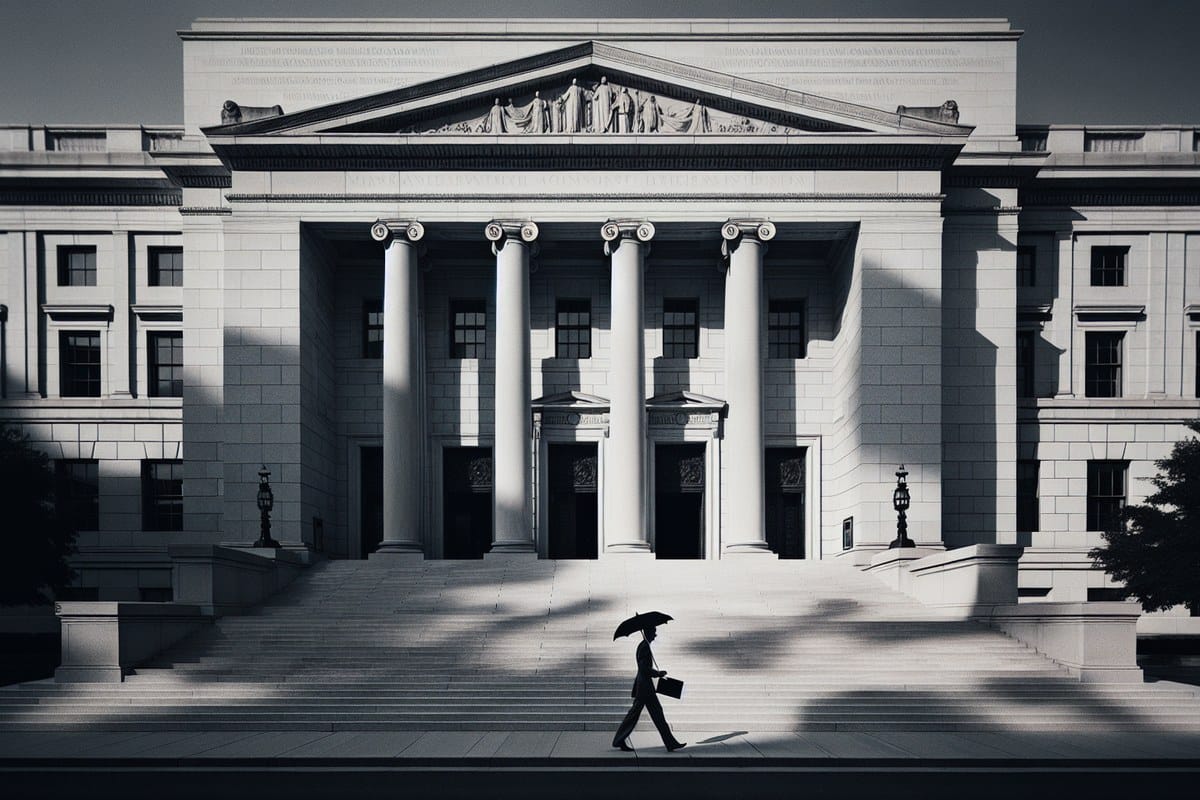
When, exactly, did we decide that the Fourteenth Amendment was a venue dispute? Because that is what the Supreme Court told us on Friday, in the polite, vowel-rich prose that institutions reserve for the afternoons they remove a load-bearing wall.
The ruling, if you read past the press releases, said that lower courts can no longer issue the universal injunctions that have been pausing the administration’s birthright citizenship order. In thirty days, the executive branch may begin enforcing the order against everyone who wasn’t personally named in a lawsuit. Which means a child born in Houston and a child born in San Antonio may now arrive into two different countries, depending on whether their parents had the foresight, the lawyer, and the standing.
I was at Eliza’s that night, in Kalorama, where the windows were open because the heat had finally broken and someone had brought a lamb. The conversation began, as conversations have begun all month, with the weather, then the Mets, then a brief, theatrical sigh about the price of strawberries. Then somebody — I think it was Judy, my sister-in-law, who has spent the last decade at the National Archives and has earned the right to interrupt — said the word “Friday,” and the room rerouted around it the way traffic reroutes around a downed tree.
The bipartisan lobbyist was there. I will not name him because he prefers not to be named, which is itself a kind of profession now. He examined his cufflink and said the ruling was “actually a quite narrow procedural decision.” Eliza said “Margaret, please,” before I had said anything, which I took as a compliment. Judy said the Archives had been quietly digitizing the original citizenship clause case files for nearly two years, and that not one reporter had ever asked her why.
I asked the lobbyist who, in his estimation, would be affected. He said the question was “interesting.” Interesting is the word a bipartisan lobbyist uses when he means he would prefer to discuss the lamb. The lamb, for the record, was excellent. The mint was from Eliza’s roof. There was unanimous consent on the mint.
By Saturday morning the op-ed pages had settled on their framing, which was that the Court had wisely curtailed the overreach of district judges. Judicial restraint, they called it — a phrase that, like “adult in the room” and “return to normalcy,” now means whatever the speaker needs it to mean before brunch. Nobody was writing about the children. The children had been filed under standing.
This is what an institution looks like when it decides to lose its nerve in installments. Not a great thunderclap, not a televised crisis. A procedural ruling on the last Friday of the term, released at an hour calibrated for the second wave of the news cycle, in which the most consequential clause in the document is converted into a question about who gets to sue on behalf of whom. The Fourteenth Amendment, after Friday, does not apply nationally. It applies in the courtrooms where someone managed to get a hearing.
I asked Judy, on the way to the kitchen, what she thought we would tell people about this in twenty years. She said the Archives don’t tell people anything. They just keep the files. She said the files are very good at waiting.
The lobbyist left early, citing a flight. Eliza brought out a cheese I had never heard of, and the bipartisan husband of a woman I will not name said the Court had merely “clarified the tools.” Somebody laughed. Somebody refilled a glass. Outside, the city was the temperature of a country that no longer asks itself whether its children are its children, or whether that is now a matter for the regional courts.
We passed the lamb. We praised the mint. We asked Eliza for the recipe, and she wrote it on the back of an envelope, and we put it in our bags, and we went home through the warm streets of a republic that has begun, very quietly, to operate by jurisdiction.