When did we decide that a man could stand in the East Room, announce that the United States would ‘take over’ a strip of land currently occupied by two million people, suggest the permanent relocation of those people somewhere — anywhere, he wasn’t picky — and that the correct response was to file it between the tariff headline and the Super Bowl prop-bet roundup? Because that is what happened on Tuesday evening, and I would like somebody, anybody, to stand up and say it happened.
The President used the word ‘own.’ He used the word ‘level.’ At one point he said ‘clean it out,’ as if describing a garage. Standing next to him was the Prime Minister of Israel, wearing the face of a man who has just been handed a check he did not expect to clear. The cameras rolled. The transcript will exist forever. And somewhere between the announcement and the eleven o’clock hour, the whole thing was quietly reclassified in the national bloodstream as one of those things the President says.
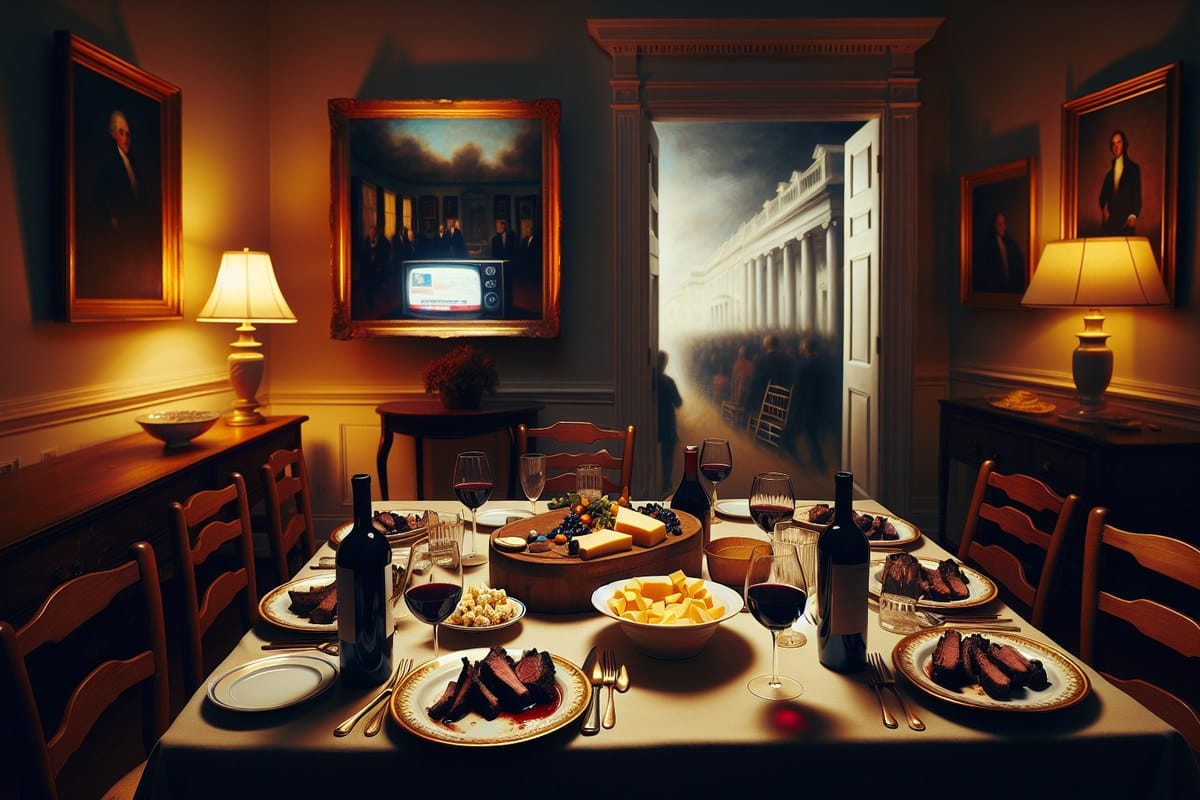
I was at Eliza’s on Tuesday. Eliza hosts a standing Tuesday supper that has, over twenty-odd years, metabolized roughly every major foreign policy crisis of the post–Cold War era over braised short ribs. The television was on in the next room, muted, the way it always is — ambient prestige, like a fireplace. The chyron said what the chyron said. I watched a senior partner at a firm I will not name glance at it, glance away, and ask whether anyone had been to the new place on N Street.
Nobody at that table was stupid. Nobody at that table was uninformed. Two of them have security clearances I am not supposed to know about and one of them used to run a desk at State. And yet the only person who said the quiet part aloud was a bipartisan lobbyist I will describe only as bipartisan, who leaned toward me over the cheese course and said, flatly, ‘That’s ethnic cleansing with a ribbon on it,’ and then asked for the mustard.
He was not wrong. He was also not going to say it on a panel, or to a client, or into any device with a microphone in it. The thing I have learned in thirty years of writing this column is that Washington does not actually lack the vocabulary for what it sees. It simply rations the vocabulary. There are words you use in private and words you use in public and the gap between those two vocabularies is where a republic goes to die.
My sister-in-law Judy, who has worked at the National Archives longer than some of the documents she handles have been declassified, called me on Wednesday morning. She had one question. ‘What are we going to file this under?’ She meant it seriously. She meant: in fifty years, when some graduate student pulls the folder, what is the subject heading going to read? ‘Reconstruction Plan, Gaza, 2025’? ‘Proposal, Voluntary Relocation of Noncombatants’? Judy, who is not a sentimental woman, said the archive always tells you what a country could not bring itself to name in the moment.
Reconstruction. That’s the word they’re floating. Reconstruction is what you do to a downtown after a hurricane. It is not what you do to a population. But the vocabulary has already shifted, the way it always shifts — first in the press release, then in the wire copy, then in the mouth of the cable anchor who has been told to stay neutral, and finally at Eliza’s dinner table, where by the second bottle it has become ‘the Gaza situation,’ a phrase that launders everything it touches.
The opposition, meanwhile, issued statements. I read them. I read all of them. They were written by people who were clearly hoping that somebody braver would go first. The Senate Minority Leader used the phrase ‘deeply concerning,’ which is what we now say instead of ‘no.’ A handful of House members with safe seats managed the word ‘unacceptable,’ and one of them actually said ‘ethnic cleansing,’ for which he was immediately described in three different outlets as ‘going further than his colleagues,’ as if naming the thing were the provocation and not the thing itself.
I keep thinking about the smile on Netanyahu’s face. It was not a triumphant smile. It was the smile of a man who has watched an American President volunteer, on live television, to absorb the international legal consequences of something Israel has wanted for a long time and could not say out loud either. You could see him calculating, in real time, which cabinet members would have to be informed and which could learn about it on the plane home.
The Pam Bondi confirmation happened the same week. USAID personnel were placed on administrative leave — globally, a word I did not think I would ever see applied to a furlough. A ten percent tariff on Chinese goods went into effect and China fired back at our coal and our soybeans. Any one of these, in a different decade, would have been the story of the month. Stacked together, they become weather. That is the trick. That has always been the trick. Flood the zone and the zone stops being a zone.
And here is what I want to say, and what I suspect my Tuesday table would rather I didn’t. A country that cannot bring itself to name a proposal for the mass relocation of a civilian population — cannot name it in its papers of record, cannot name it at its dinner tables, cannot name it on the Senate floor — is not a country having a debate. It is a country practicing a silence. The silence is the policy. The silence is what gets filed in Judy’s folder.
I am told, by friends who mean well, that it will not actually happen. That the logistics are impossible, the allies will balk, the courts will intervene, the thing will collapse under the weight of its own unseriousness. Perhaps. I have been told a great many things will not happen, over thirty years, and a surprising number of them have. The useful question is never whether a thing will be executed. The useful question is what it costs a country to hear a thing proposed and decline to flinch.
We heard it. We declined. The salad kept moving around the table. Somebody, eventually, is going to have to explain to Judy’s graduate student what the heading should read, and I suspect the honest answer is going to be the one none of us wanted to write down on Tuesday night.