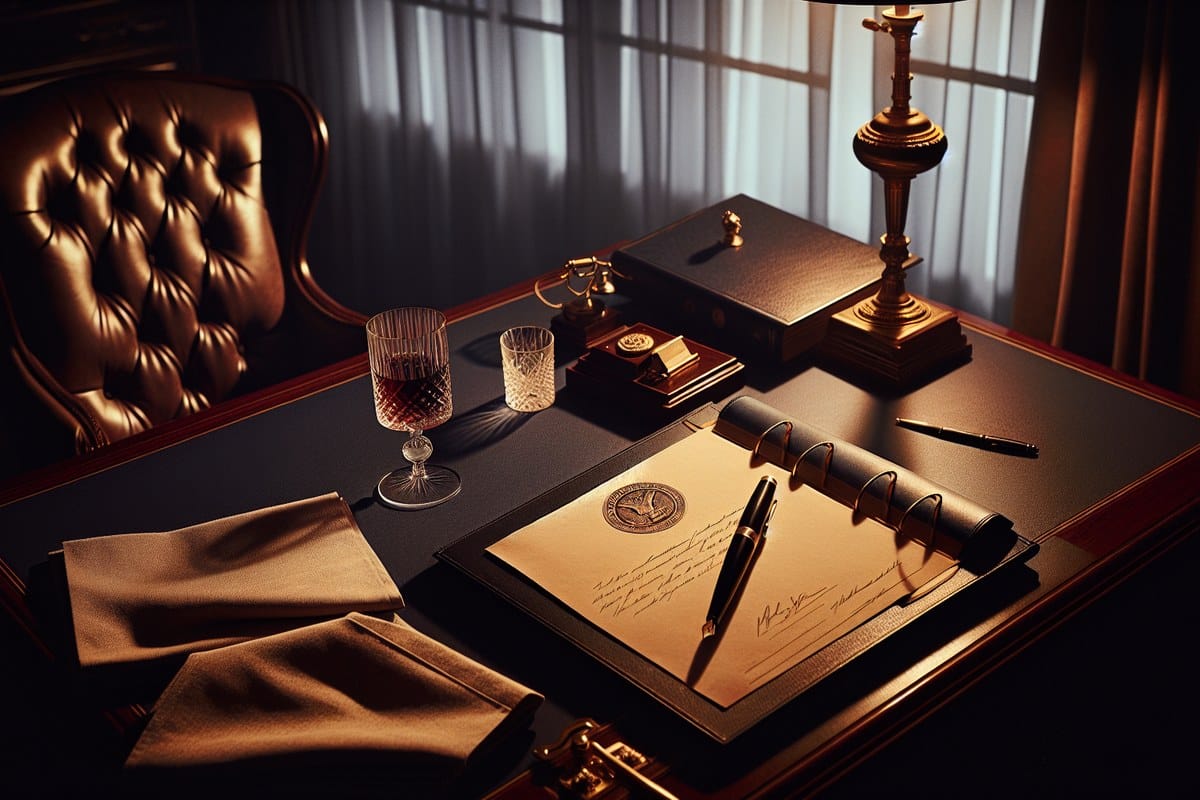
There was a moment Wednesday night — somewhere between the endive salad and the second bottle of a Willamette Valley pinot my friend Eliza insists on bringing to every dinner whether or not it pairs — when the bipartisan lobbyist at the end of the table leaned back, dabbed his mouth with a linen napkin, and said, of the day’s signing ceremony: Well, that one was free. Nobody disagreed. Nobody followed up. A plate moved. The host asked about the dessert course. This is, I have come to understand, how things work now in the capital that used to at least pretend to govern.
The president signed an executive order Wednesday barring transgender women from participating in women’s sports. I watched the clip twice, because I am old enough to remember when a presidential signature was supposed to be a serious instrument and not a prop in a middle-school play about serious instruments. The pen came out. The cameras clicked. The men behind him arranged their faces into the expression Washington men have been practicing since the Bush administration — the one that says I am a grave person considering a grave matter — and then everyone went to lunch.
I am going to do something that used to be called journalism and ask a plain question: what, mechanically, does that order do? The NCAA already shifted its policy. The major women’s sports federations have been making their own rules for years. The actual population affected by this order, in the entire country, in any given competitive season, numbers somewhere between a rounding error and a statistical ghost. If the federal government were a household, it would be the equivalent of calling a family meeting to announce, with solemnity and a signed proclamation, that henceforth no one is allowed to put pickles in the blender.
And yet — and this is what my sister-in-law Judy, who has spent thirty years at the National Archives watching presidential paper come and go, keeps trying to tell anyone who will listen — the order is not for anything. The order is of something. It is of a new kind of governance where the document is the deliverable, where the news cycle is the constituency, where the point of the signature is to be photographed signing.
I have no patience for the argument that this is unprecedented. Every administration in my memory has reached for the executive order when Congress became too tedious to persuade, and every administration has been lectured about it by the party out of power and then done exactly the same thing upon returning to power. What has changed is the ratio. The orders used to at least pretend to be the last resort. Now they are the first, and often the only, move. The pen is not an instrument of executive authority anymore. It is a content-creation tool.
Eliza — who is, I should disclose, the sort of person who will tell you she voted for nobody in the last three elections and expects to be congratulated for it — asked the table a question I thought was worth the price of the pinot. Name one piece of actual legislation, she said, that has cleared both chambers and been signed into law in the last six weeks. The bipartisan lobbyist laughed. A woman from Treasury changed the subject to a restaurant on P Street. Nobody produced a name. I did not produce one either, and I read four newspapers before breakfast.
This is what I mean by civic cowardice, and I mean it in the precise, unflattering sense. It is not cowardice to sign a culture-war order; signing culture-war orders is in fact the opposite, a kind of cheap courage, the courage of knowing the cameras are already on. The cowardice is in the rest of it. The cowardice is in a Congress that has discovered it no longer has to do anything, because the executive branch will do the performance for them and the judiciary will sort out whatever survives. The cowardice is in a press corps that will cover the signing as news and the absence of legislation as gridlock, as if those were two separate weather systems and not the same storm.
I want to be careful here, because this column has a bad habit of being read by people looking for ammunition. I am not interested, today, in relitigating the sports question itself, which is a real question with real pain on more than one side of it and which deserves a seriousness that a twenty-second Oval Office photo op is structurally incapable of providing. I am interested in the instrument. I am interested in what it says about us that our government, such as it is, has decided the signature is the work.
Somebody at the table — I think it was Eliza’s husband, who is a lawyer of the kind who uses the word optics without irony — said the quiet thing. He said: It’s fine. The courts will handle it. And there it was, the whole theory of modern American governance in six words. The president signs. The courts handle it. Congress raises money. The voters are given a show. The show is the policy. The policy is the show.
I asked Judy, the next morning over the phone, whether any of this would look different a hundred years from now when some other archivist is pulling these orders out of a box. She said the orders themselves would look fine. They always look fine, she said. It’s the absence around them that tells you what was happening. I have been thinking about that sentence for two days.
So here is what I am sitting with, on a gray Wednesday in February, while Washington congratulates itself on another productive signing day. A country that has outsourced its legislature to its executive and its executive to its media operation is not a country that is governing itself. It is a country that is watching itself be governed, and clapping at the parts it recognizes, and going home.
The signatures are the cheapest thing in this city. They have always been cheap. What used to be expensive was the work underneath them. I do not know anyone, in or out of government, who could tell you with a straight face that the work is still being done. And the dinner parties, I notice, are getting quieter at exactly the moments they used to get loud.