What is a war power, exactly, if the body constitutionally assigned it will not lift a finger to exercise it? I asked a version of that question Tuesday night at Eliza’s, and got an answer I am still turning over.
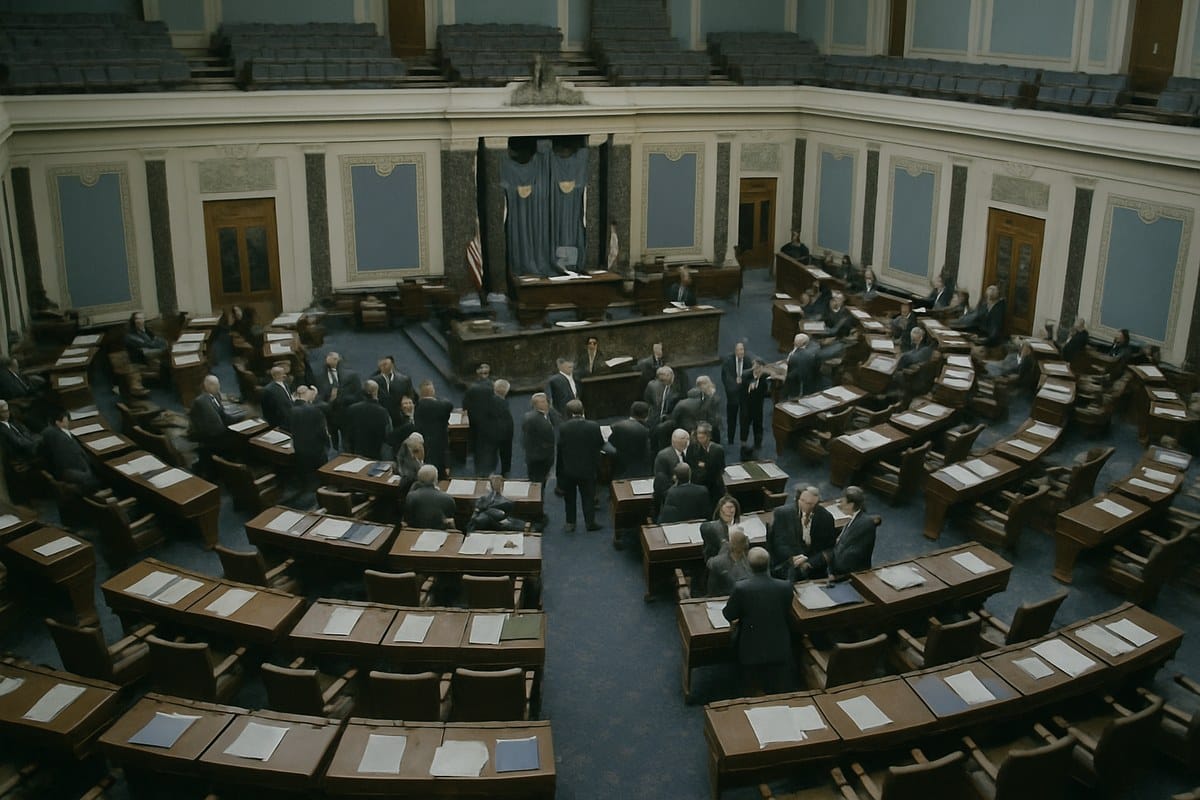
The Senate had voted earlier that day, 52 to 47, to reject a resolution that would have required the White House to halt hostilities in Iran without further congressional authorization. The resolution did not demand withdrawal. It did not condemn anyone. It merely asked the Senate to remember, on paper, that the Constitution had assigned it a job. Fifty-two senators declined the reminder.
Eliza was serving a shoulder of lamb she had been talking about for two weeks, and had seated me next to a lobbyist she introduced only as “bipartisan” — a description he did not correct. He worked, he said, “on both sides of the aisle, when there are sides.” He was examining his cufflink when the vote came up.
“The resolution was never going to pass, Margaret,” he said, in the tone one uses to explain to a child why the ice cream truck is not coming back. “Everyone knew that going in. That was, in a way, the point of scheduling it.” I asked what the point was, exactly. He said the point was that it had been scheduled.
My sister-in-law Judy, who has spent her career at the National Archives cataloging documents nobody else has read, said the War Powers Resolution of 1973 was still, technically, in her building. She said this the way a doctor tells you about a growth that isn’t currently doing anything. The lobbyist nodded and reached for the salt.
The forty-seven who voted yes did not, I should say, cover themselves in glory either. Several of them gave floor speeches about the sanctity of Article I and then walked off camera to reporters and clarified that they would, of course, support the ongoing operations, and that the vote had been “about process.” In this town, “about process” is the phrase you use when you would like credit for a position you are not, on inspection, taking.
Someone at the far end of the table — I think it was the deputy general counsel of something, though I lost the introduction — asked if we could please talk about anything else. Eliza laughed and asked whether anyone had been to the new place on P Street. The bipartisan lobbyist said he had, and the fish was very good, and that is what we did with the rest of the evening.
I keep thinking about the fifty-two. Not because I expected them to vote differently — I have been here too long to expect that — but because of the specific tenderness with which they explained afterward that the vote had not really been a vote. The war, they seemed to be saying, would proceed under its own steam, and the Senate would take up the question again the next time nobody was watching.
We called it the lamb course. We asked Eliza for the recipe. The forty-seven were still, presumably, in their offices, drafting statements to explain what they had almost done.