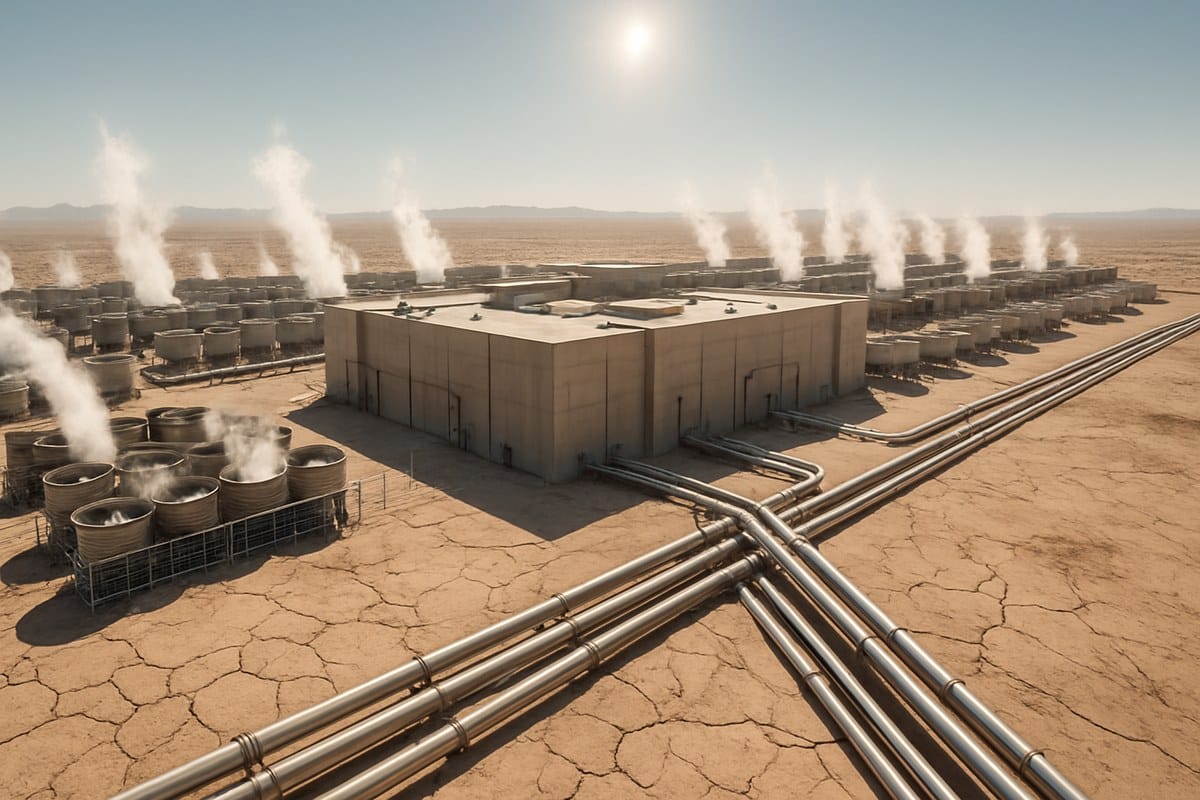
SAN JOSE, CA — Nvidia closed its annual GTC conference Thursday with the unveiling of its next-generation Vesper accelerator, a chip the company described from the main stage as roughly twice as fast as last year’s flagship and which, according to the very next slide, will require approximately four times the cooling water and triple the grid draw to operate at advertised performance.
CEO Jensen Huang, in his customary leather jacket and tone of religious conviction, called the trade-off “the new physics of intelligence” and assured a packed auditorium of analysts, hyperscaler executives, and visibly perspiring municipal utility planners that the math, while counterintuitive in the short term, would prove correct over a sufficiently long horizon, possibly several quarters.
Maricela Doss, a deputy director at the Western Watersheds Council, said she had spent Thursday morning reading the Vesper technical datasheet “like a horror novel,” and noted that the projected per-rack consumption worked out, by her arithmetic, to a small municipal swimming pool refilling itself roughly every eleven minutes. She added that the slide labeled “Sustainability” had been a photograph of a forest, with nothing else on it.
The keynote also included a memorandum of understanding with a county in western Arizona to “explore options” for tapping a non-municipal aquifer, a partnership with three utilities to fast-track dedicated substations, and a brief, warmly received appearance from a Microsoft executive who described the announcements as “exactly what we ordered, plus interest.” At no point did anyone on stage say the word “gallons.”
Wall Street received the news as a kind of benediction. Nvidia shares climbed 6.4 percent in after-hours trading, with one note from a Morgan Stanley desk arguing that quadrupled water usage should actually be considered bullish on the grounds that it represented a deeper moat against competitors who would also need water but did not yet have the helpful relationships with Arizona counties.
Asked about the resource curve after the keynote, an Nvidia spokesperson directed reporters to a forthcoming whitepaper and noted that the company’s data-center partners were committed to “net-positive water stewardship by 2035,” a phrase that, pressed for definition, the spokesperson said meant the company was committed to using the phrase.
Reaction outside the convention center was more textured. Earl Quinones, a water planner from a town of 4,100 in West Texas who had driven up uninvited and was standing in the lobby holding a folder, said he had come to ask one specific question about a proposed Nvidia-adjacent build near his municipal well field. By Thursday afternoon he had not yet been able to ask it, but had been handed two branded tote bags and a cold brew.
The conference closed with a teaser for the chip after Vesper, which Huang promised would be substantially more efficient, a term he defined as performing twice the work for only six times the resources. The crowd applauded. A man in the third row, identified by his lanyard as representing a utility cooperative in central Nebraska, did not.