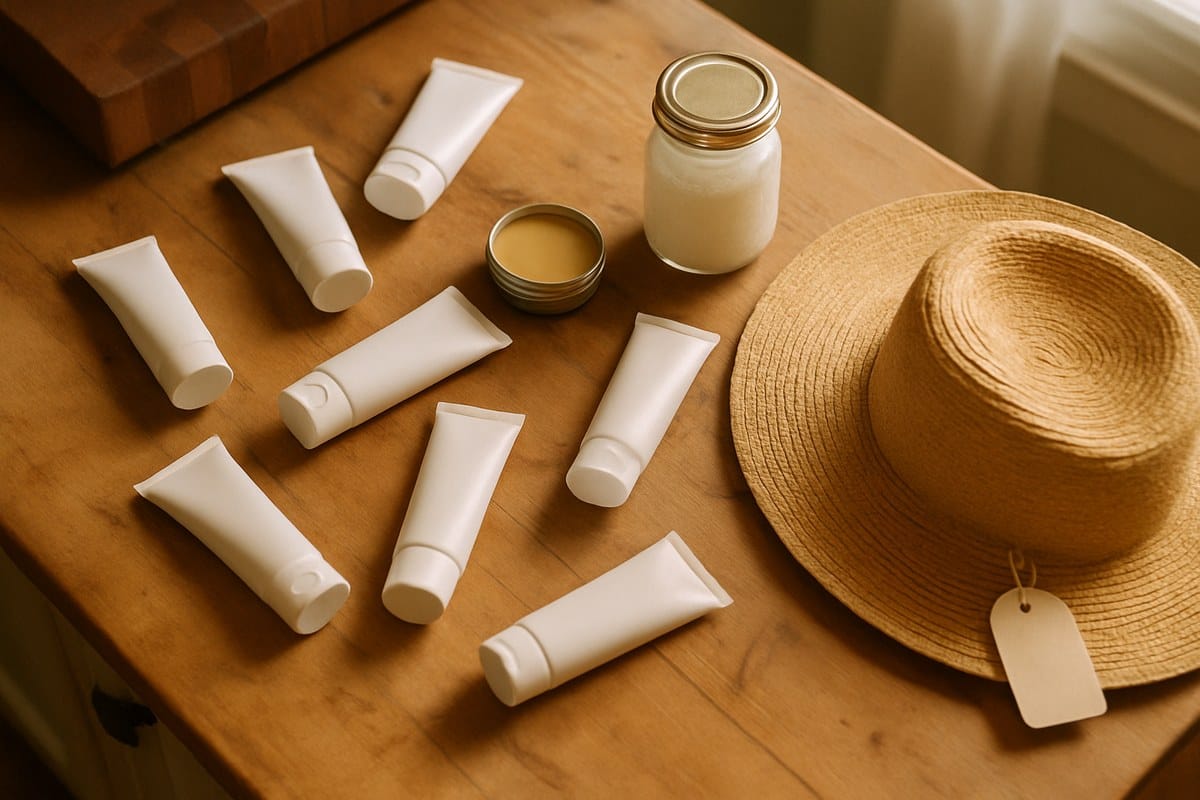
Marlene came over Tuesday with a plastic CVS bag and emptied it onto my kitchen island like she was unloading a tackle box of evidence. Eight tubes of sunscreen, all with the receipt stapled to the cap. “We are leaving for Tybee in nine days,” she said, “and I refuse to be the one who lets octocrylene happen to our children.”
I love her for this. I also did not know what octocrylene was until Marlene started reading the back of a Banana Boat bottle out loud in the voice she uses when she’s pretending to be calm. By ingredient four she had her glasses on. By ingredient seven she was pacing. By the time she got to “may contain benzene as a manufacturing byproduct,” she was holding the tube the way you hold a mouse you caught in a trap and don’t want to look at.
Her source on this is a Facebook group called Seed Oils, Sun Care, and the Quiet Cost, which has twenty-two thousand members and a pinned post that is just a photograph of a bottle of Coppertone next to a bottle of WD-40 with no caption. She says the caption is the point. I don’t know how to argue with that, and frankly I don’t want to.
The thing Marlene keeps coming back to is the SPF number itself. “SPF 30, SPF 50, SPF 70 — those are too round, Brooke. Those are marketing numbers. The sun doesn’t move in increments of ten.” Her sister-in-law Pam, who works the front desk at a dermatology office in Hendersonville and is therefore basically a dermatologist, told her that the real protection “plateaus around SPF 19,” which Marlene has decided means anything above that is just chemicals looking for somewhere to live. I asked which chemicals. She said “the ones with the y in the middle,” and honestly that did track with the bottle in her hand.
What’s allowed, per Marlene, is zinc oxide “but only the kind that goes on like cake frosting and you have to rub for four minutes,” beef tallow balm from a woman in Weaverville who sells it out of a cooler at the farmer’s market, and coconut oil, which she acknowledged goes rancid in roughly the time it takes to drive to the beach but said “rancid is a word the FDA invented to scare us off fats.” She also said sun exposure before 10 a.m. is “a vitamin, not a risk,” which is the exact same logic she used in February when she told Cleo to stare at a candle for her circadian rhythm.
Garrett, who is a reasonable man and also tired, tried to point out that we used Coppertone for three decades and the country is still standing. Marlene looked at him with the soft pity she reserves for men who don’t read labels and said, “Garrett, define standing.” He went outside to bring in firewood we don’t need in March.
Cleo has been outfitted with a long-sleeve rash guard, a wide-brim hat, and a pair of UPF leggings Marlene ordered from a small company in Maine that mails its products in unbleached paper because “bleached paper touches the fabric and then the fabric touches the child, Brooke, do the math.” The leggings cost ninety-four dollars and arrived with a handwritten note from a woman named Sigrid. Cleo wore them to school yesterday and a kid asked if she was a beekeeper. She said yes. We are letting that one ride.
The compromise we landed on for the actual beach is a small tin of the Weaverville tallow, a pint mason jar of coconut oil that I will be replacing twice a day from a cooler in the car, and what Marlene calls “shade architecture” — two umbrellas, a pop-up tent, and a beach blanket she sewed a canopy onto using leftover canvas from the chicken coop. Pam approved the setup over text. Pam used three thumbs-ups and a sunflower.
Marlene left around four, taking the eight CVS tubes with her because she didn’t want them in our trash where they could “off-gas into the recycling.” She said she’s driving them to a hazardous-waste site in Buncombe County on Saturday. Then she came back through the door to grab one more thing off the island. Six wide-brim hats, still tagged, in graduated sizes. “I got one for everyone,” she said. “Even Garrett. Especially Garrett.”