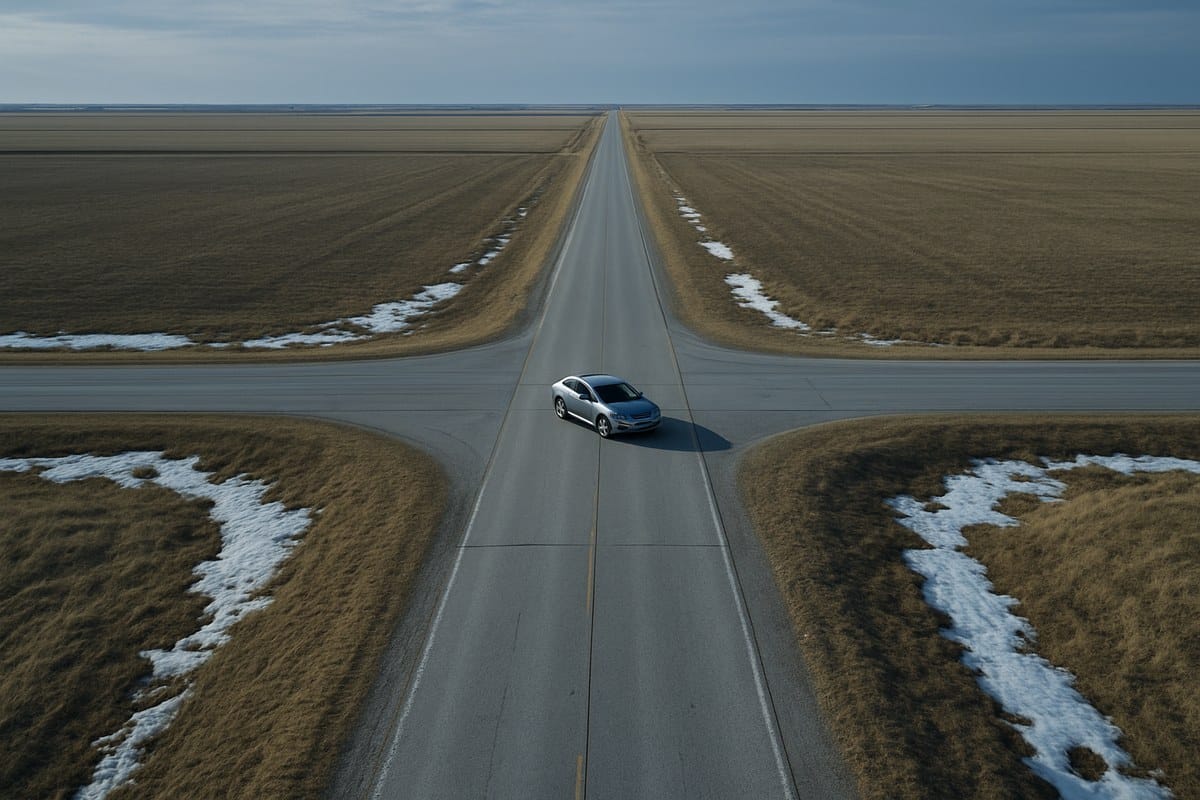
What does a state do when it has run out of useful problems to solve? It invents one, of course, and on Tuesday the Kansas Legislature invented a beauty. It voted to suspend the driver’s licenses of every transgender resident in the state. Not restrict. Not flag. Suspend. As of this writing, several thousand Kansans are legally forbidden from driving to work, to the pharmacy, or to their mother’s house in Hutchinson, because the state has decided their licenses are now philosophical documents rather than practical ones.
I read the news Tuesday afternoon and then I went to dinner.
The dinner was at Eliza’s, in that yellow house off Wisconsin she and Charles have been renovating since the second Obama term. There were eight of us. Eliza had made a brisket, which she does when she suspects the conversation will need ballast, and she had warned me on the phone that one of the other guests was a bipartisan lobbyist — her word, bipartisan, which in this town means a man who will not tell you what he believes because he has not yet been paid to believe it.
I brought up Kansas over the salad course. I am told this is a thing one is not supposed to do anymore at dinner, the way one was not supposed to discuss the Pentagon Papers in 1971, or the savings-and-loan business in 1989, or any number of other things one was eventually quite glad somebody discussed.
The bipartisan lobbyist examined his cufflink. Charles asked who wanted more wine. A woman whose name I did not catch — she does something at State, I gathered, the way other people do something with horses — said the word “federalism” with the calm authority of someone reading it off an index card. Eliza put her hand on my forearm and said, “Margaret, please.” She has been saying “Margaret, please” to me at her dinners since the first Clinton administration, and the meaning has not appreciably changed.
My sister-in-law Judy, who works at the National Archives and who has therefore developed a professional immunity to euphemism, was not at the dinner, but I called her on the way home. She said the thing I knew she would say, which is that they used to call this kind of measure a “civil disability,” and that the phrase had gone out of use sometime after Reconstruction because it had become embarrassing. “Now they just don’t name it,” she said. “That’s the upgrade.”
I want to be careful here, because I am told I am shrill when I am not careful. So let me be precise. A driver’s license, in most of the United States and certainly in Kansas, is not a luxury. It is the document that lets you exist as an adult — to cash a check, to buy cold medicine, to be pulled over and let go. Suspending it is not symbolic. It is the state telling a category of people that their daily errands are now a favor the state may, at its discretion, withdraw.
The conversation at Eliza’s eventually moved, as conversations there always do, to the renovation. The contractors had found something behind the dining-room wall. Original wainscoting, beautifully preserved. Everyone agreed it should be saved. There was real feeling in the room about the wainscoting. There was unanimous consent.
I am, as my readers know, just asking questions. I am asking what kind of country issues a press release on a Tuesday afternoon stripping several thousand of its own citizens of the right to drive themselves to the dentist, and then expects the rest of us to consider it one item among many in a busy news cycle. I am asking which guest at the table is going to say something the next time, and which guest is going to ask for more wine, and whether those are going to turn out to have been the same guest all along.
The brisket, for what it’s worth, was excellent. Eliza used her mother’s recipe. We all asked for it on the way out.