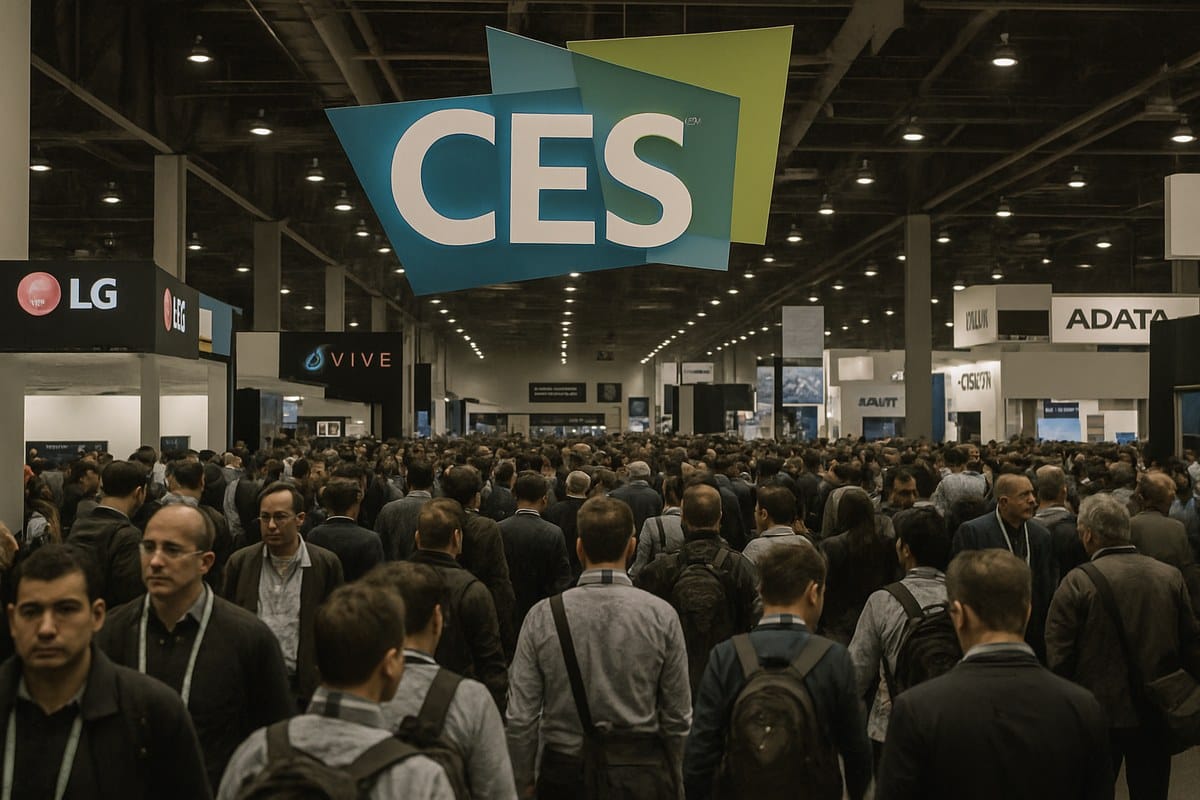
LAS VEGAS — The 2026 Consumer Electronics Show opened Tuesday at the Las Vegas Convention Center with what organizers called a record number of exhibitors, nearly all of whom appear to be selling the same touchscreen affixed to a different household object that previously functioned without one.
Among the products debuted on the show floor in the first six hours: an AI-powered toothbrush, an AI-powered cutting board, an AI-powered bird feeder, an AI-powered shower curtain rod, and a $1,240 AI-powered planter that emails its owner when a basil plant is, per the company’s literature, “feeling unheard.”
“The category has matured,” said Imani Reuss, a hardware analyst at the consumer-tech research desk MERIDIAN-3, gesturing toward a wall of forty-two identical voice-activated doorbells produced by forty-two unaffiliated companies. “Last year you’d see maybe forty firms racing to put a chatbot inside a kettle. This year there are nine hundred. That’s growth.”
Two aisles over, a Bay Area robotics startup demonstrated a humanoid assistant capable of folding a single dish towel in approximately four minutes, while a crowd of venture investors filmed the performance and a representative explained that pricing was “still being workshopped” but would likely land somewhere between $34,000 and “whatever the customer has on them.”
Several exhibitors privately acknowledged that the underlying intelligence powering their products is, in most cases, the same three large language models licensed from the same three companies in Mountain View and San Francisco, repackaged behind injection-molded enclosures in seven colors. “We add the personality layer,” said a Belgian founder whose smart bathroom mirror tells users they look “rested” regardless of inputs, time of day, or whether anyone is standing in front of it.
The autonomous-vehicle pavilion, occupying roughly the footprint of a regional airport, featured eleven different self-driving shuttles successfully navigating a closed track marked with orange cones. A twelfth shuttle remained stationary throughout the demo period, attended by two engineers who declined to specify what it was doing.
The Consumer Technology Association estimated that products debuted on this week’s show floor would, by 2028, account for roughly 11 million pounds of electronic waste, most of it bricked the moment a startup’s cloud service is quietly sunset in a Medium post. Asked about the figure, an association spokesperson said the association had not been asked about the figure.
Foot traffic in the “Ambient Living” hall skewed heavily toward attendees in their late fifties and sixties, several of whom were observed nodding gravely at a refrigerator that suggested recipes based on what it imagined was inside it. A cluster of Gen Z attendees near the EV pavilion, asked what had drawn them to CES, cited the free water bottles and a rumor about a Doja Cat appearance that had not been substantiated.
By late afternoon, three separate booths had quietly removed signage promising “ambient intelligence” after attendees kept stopping to ask employees what that meant. The booths remained otherwise unchanged, still demonstrating, in one case, a toaster that can describe its own limitations in conversational English.
The show runs through Friday. A representative for the planter company said the basil was doing better.