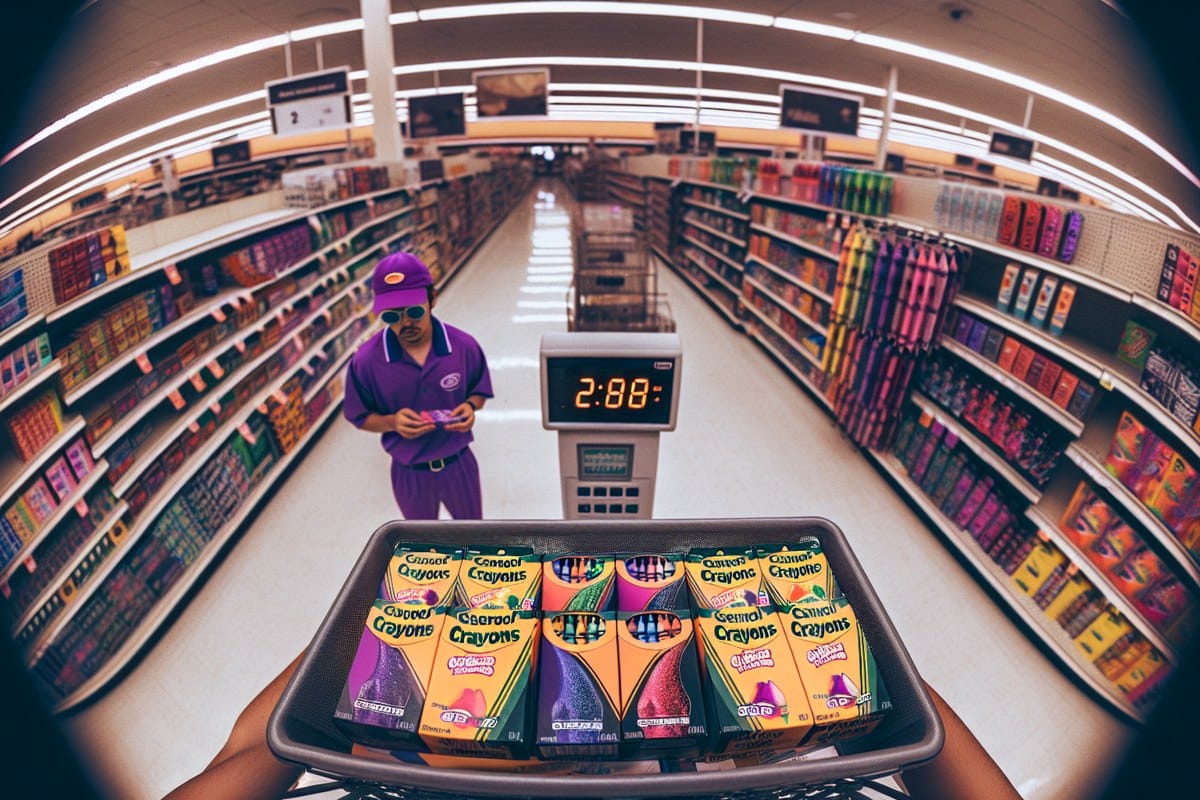
MINNEAPOLIS — A 24-count box of Crayola Classic Colors briefly cleared at $11.40 on Sunday evening at the Target on Nicollet Mall, the highest print the assortment has registered since the company began quietly rolling its back-to-school aisle onto dynamic pricing earlier this month.
The electronic shelf label, a small grey rectangle blinking a faint amber every few seconds, had moved the box up four times between 6 P.M. and the 7:42 peak, at which point a man in a Vikings polo holding two sparkling waters audibly said “come on” to nobody and walked the crayons back to the endcap. By 7:51 the box was $6.79 again. By 8:14 it was $9.20. The Target carried no signage acknowledging that any of this was happening.
Internally the program is called Smart Shelf, according to a vendor rep who was at the store unrelatedly to restock loose-leaf and asked that his name not be used because, as he put it, “I sell paper, man, I just sell paper.” Smart Shelf reprices roughly 1,400 SKUs across school supplies, lunch packaging, and what the company classifies as “emotional adjacencies,” a category that includes mechanical pencils, Lisa Frank folders, and the small zippered pouches that hold them.
Pricing analytics have been outsourced to Halberd Forecasting, a firm whose model ingests local school-district calendars, weather, and what its founder Marin Choe describes as “the late-Sunday capitulation curve,” a behavioral signal Choe says peaks each August between 7:30 and 8:15 P.M. when parents accept that the supply list is real. “Crayolas are inelastic in that window,” Choe said. “You’re not driving to a second store at quarter to eight on the night before school. We’ve modeled that.”
By Monday morning, several SKUs in the aisle had begun displaying a thin secondary line beneath the price, formatted in a way that longtime traders may find familiar: a bid and an ask. A pack of Elmer’s glue sticks (six count) was trading $4.20 / $4.55. A protractor was wide, $1.10 / $2.30, on what one shopper called “basically no volume.” A clerk restocking pink erasers said the spreads were “a glitch they’re working on,” then added that they had been working on it since Thursday.
Reached for comment, a Target spokesperson said the program was “a guest-centric pricing experience that reflects real-time shelf conditions” and emphasized that prices can move down as well as up, a claim the company supported by noting that a pack of mini composition books had briefly hit 89 cents at 4:11 A.M. last Tuesday, when no one was in the store. The spokesperson declined to say whether the algorithm could be paused, citing what she described as “the integrity of the curve.”
Parents in the aisle Sunday handled the volatility with varying degrees of grace. One woman, a paralegal named Annie Vossberg who had a Dr. Pepper in the cart and a kindergartener orbiting her left leg, watched the crayon price tick from $9.80 to $10.60 and quietly said “okay” in a tone that her child, sensing nothing, repeated back to her. She bought the crayons. The box went to $7.20 nine minutes later.
Halberd’s model, per Choe, projects the August peak to compress further next year, with the optimal Crayola entry point migrating to roughly 6:15 P.M. on the third Sunday of the month and the optimal exit point being, in his words, “never, you have to buy them, your kid needs crayons, that’s the whole trade.”