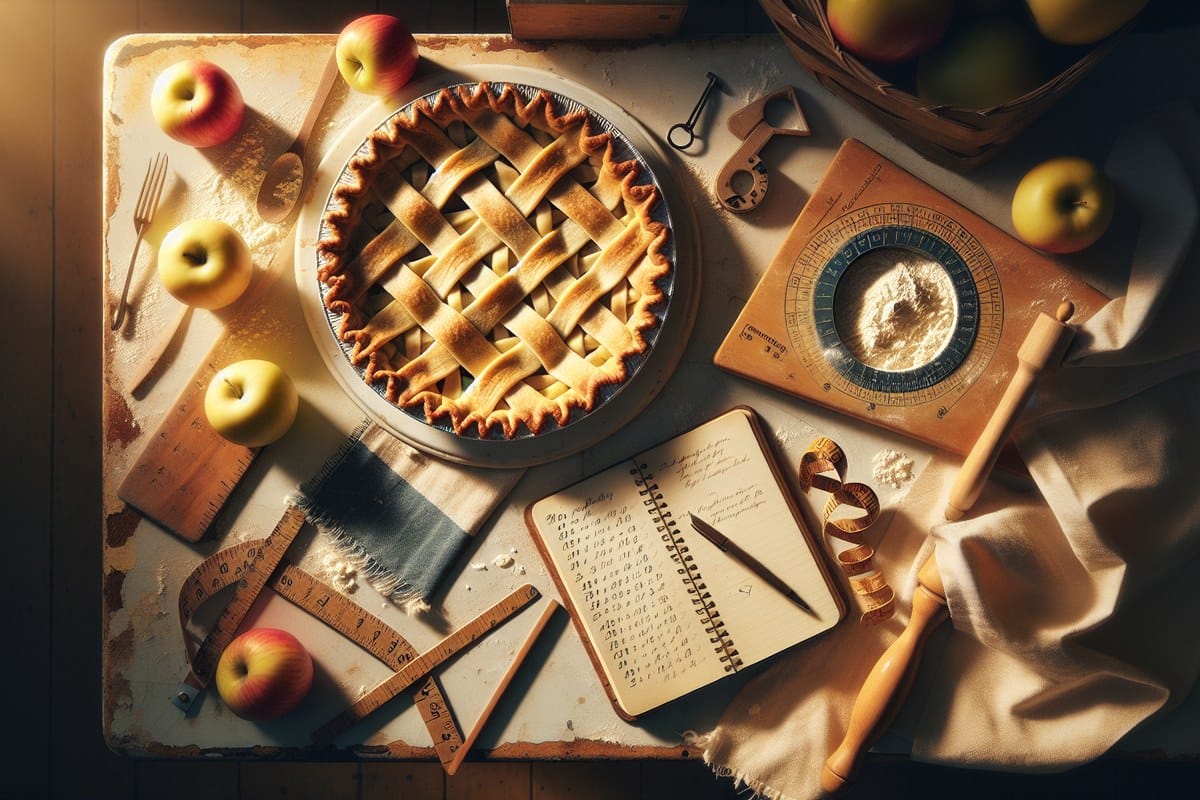
I want to be clear that I did not set out to make a scene at the Harris Teeter on Tunnel Road. I set out to verify something. The bakery manager — a very kind man named Dale — watched me press a cloth measuring tape around the rim of a Dutch apple, write a number in my notebook, and move on to the cherry crumble, and at no point did Dale ask me to leave. He just got quieter.
This whole project started Tuesday night, when my friend Marigold posted in our Facebook group (Real Math for Real Mothers, almost 4,000 members, very civil) that pi is classified as a “transcendental” number, which she pointed out is the same word people use for meditation retreats and yoga studios that charge $48 a class. Her question was simple: why is the most famous number in our children’s school curriculum a number that goes on forever and cannot be pinned down? Nothing in nature is irrational. A pinecone is not irrational. A nautilus shell is not irrational. So who decided pies were?
I went to four stores. I measured 23 pies. I used a soft cloth tape from my sewing basket because my sister-in-law Tasha — she works the front desk at a pediatric office in Hendersonville and is basically a nurse — has told me before that metal measuring tapes introduce a small electromagnetic field that can throw off readings on anything fermented, baked, or “made with love at scale.” Pies qualify on at least two counts.
The numbers were not good, friends. The Sara Lee Dutch apple came in at 3.02. A Marie Callender’s chocolate silk measured 3.41, which is not even close. A store-brand pumpkin from Ingles registered 2.89, which technically isn’t pi, it’s just a circle having a bad day. The only pie that came within a tenth of 3.14 was a key lime from a Publix in Arden, and that one had a graham cracker crust, which Tasha says “barely counts as a baked good in the eyes of God or the FDA.”
I want to stress that I am not a conspiracy person. I am a mother of four with a five-acre homestead and a working dehydrator. But when I called the consumer line at one of the major frozen pie companies (I won’t name them, they were polite) and asked what their target circumference-to-diameter ratio was, the woman on the phone said, and I am quoting from my notebook, “ma’am we don’t measure them like that, we measure them in inches.” Inches. As if a pie is a piece of lumber.
For comparison, I baked my own apple pie Wednesday afternoon with a sourdough crust I’d been cold-fermenting for nine days, butter from the Jersey cow share at the farm down Old Fort Road, and apples I picked and stored myself in October. I made it during a waxing gibbous moon, which Marigold says is the only moon phase where geometry behaves. Wade timed me. The pie measured 3.14159 on the nose. He measured it twice because the first time he didn’t believe it either.
Ember, who is six and has been asking sharper questions since her TikTok detox, wanted to know why the store pies were lying. I told her that some pies are made by people, and some pies are made by buildings, and the buildings don’t always tell the truth. She nodded the way she nods when she already knew. River asked if we could still eat the Marie Callender’s. We could not. I’d cut into it for the radius measurement and Wade said it tasted like a candle.
Here is what I think is actually going on. Pi Day is not about math. Math doesn’t need a holiday. Math is doing fine. Pi Day is about getting American families to consume roughly four pounds of bleached flour, soybean oil, and “natural and artificial flavors” between 3:14 PM and bedtime in the name of a Greek letter most of us couldn’t draw. It is a marketing holiday wearing a graduation cap.
I’ll be celebrating tonight the way my grandmother would have — with a bowl of raw cream, a small bowl of honey, and the protractor I borrowed from Beck’s math binder. If anyone needs me, I’ll be in the kitchen, measuring things that have nothing to hide.