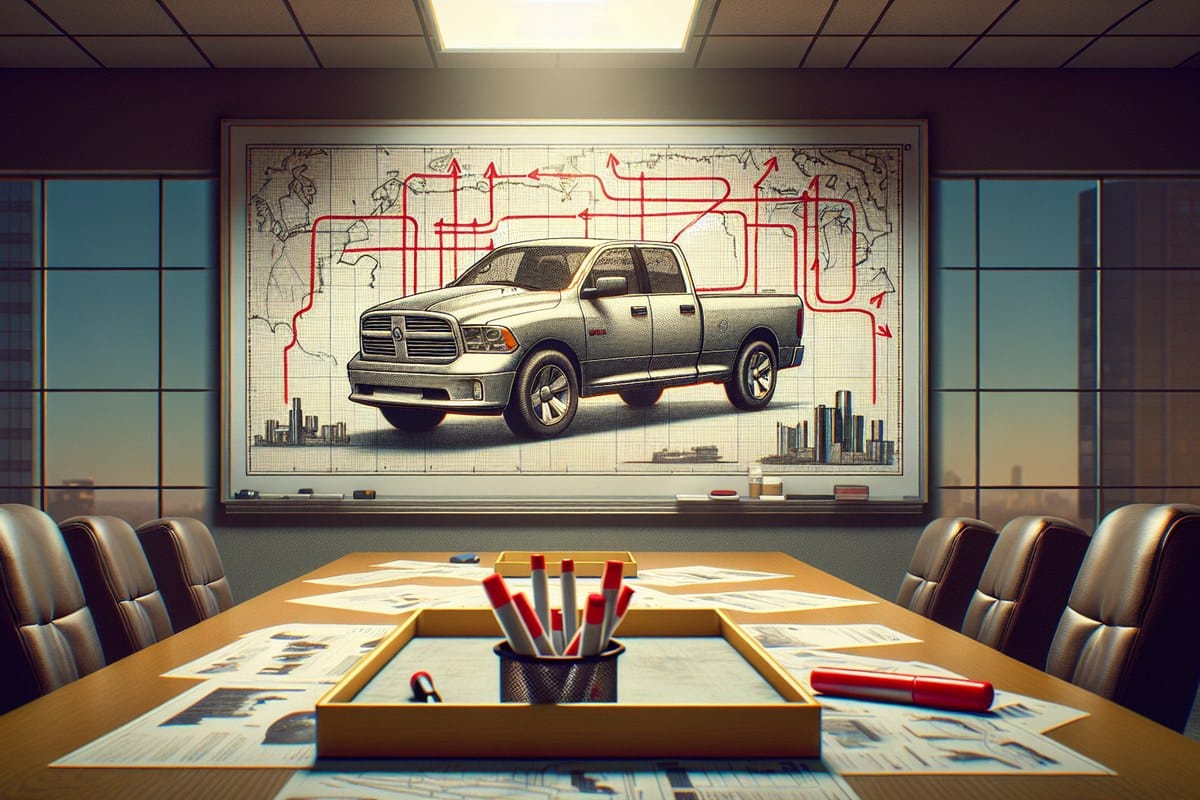
DEARBORN, MI — Executives at the Big Three automakers spent most of Wednesday afternoon in a conference room with a whiteboard, a red marker, and the patient expression of parents explaining to a toddler why the dog is not, in fact, a horse. On the board was a diagram of a single F-150, and on the diagram were eight separate arrows indicating the eight separate times its various components cross the U.S.-Canada border before the truck is legally considered a truck.
The tutorial followed the administration’s Wednesday confirmation that 25 percent tariffs on Mexican and Canadian goods will take effect March 4, a date auto supply chain managers have been circling on their calendars the way medieval peasants circled the arrival of a comet.
“The engine block is cast in Windsor, machined in Ohio, sent back to Ontario for the cylinder heads, then down to Kentucky for assembly into the powertrain,” said Margaret Velasco, a senior supply chain economist at the Center for Applied Trade Realism. “By the time that truck rolls off the line in Dearborn, the tariff on it, if you stack every crossing, is somewhere between 127 percent and a polite request that we stop making trucks entirely.”
Velasco noted that the number “eight” is actually conservative. A single wiring harness, she said, can cross the border three times on its own, “mostly, as far as anyone can tell, for emotional reasons.”
Industry executives have reportedly been careful to frame their concerns in the most non-confrontational language available to the English-speaking world. One Ford vice president’s Tuesday memo used the phrase “we would love to better understand the mechanics of the policy” eleven times, which trade analysts identified as the corporate equivalent of screaming into a pillow.
At a Stellantis facility in Sterling Heights, a plant manager demonstrated the issue using a child’s pop-up book he had apparently commissioned from a local print shop. Each page showed the same alternator flying across the 49th parallel, with a small cartoon customs officer waving wearily. “We thought visuals might help,” he said.
The White House, for its part, has maintained that the tariffs are straightforward and that automakers are, in the words of one senior adviser, “overcomplicating what is essentially a vibe.” The adviser declined to say which parts of a pickup truck constitute the vibe and which parts are merely the truck.
Dealerships, meanwhile, have begun adjusting sticker prices with the preemptive enthusiasm of a man who has been told it might rain and is therefore already wearing a full wetsuit. A Chevy lot outside Toledo has reportedly added a “Border Uncertainty Fee” of $1,847 to every vehicle, including used sedans that have not crossed any border since the Bush administration.
“We don’t know if the tariff will happen, get delayed, get rescinded at 10 p.m. on March 3, or just transform into something else entirely, like a tax credit or a tweet,” said Randy Chen, the lot’s general manager. “So we priced in all of them. It’s actually more honest this way.”
Canadian parts suppliers in Ontario have begun preparing what one trade group described as “contingency plans,” which on inspection turned out to be a shared Google Doc titled “lol what now” containing a single line reading “call Brian.” Brian could not be reached for comment.
Mexican auto parts manufacturers, for their part, issued a joint statement expressing confidence in the resilience of North American trade relationships, immediately after which their stocks fell 4 percent and their CEOs boarded a flight to a summit in Monterrey that three people in the room confirmed was not previously on the calendar.
Consumer advocates have begun warning that the price of a new pickup truck could rise by as much as $6,000 under the full tariff regime, though one analyst cautioned against precise estimates. “We’re modeling against a policy that has been announced, delayed, un-delayed, re-announced, and partially hallucinated,” said Dr. Peter Oyelaran of the Midwest Institute for Industrial Policy. “At this point we’re not forecasting, we’re doing improv.”
Back in Dearborn, the whiteboard session ended around 4 p.m. when someone realized that the diagram had grown to include a small inset showing the journey of a single bolt, which travels from Indiana to Sonora to Windsor to a separate facility in Windsor before returning to Indiana. An executive stared at it for a long moment, capped the marker, and suggested the group break for coffee.
The coffee, he noted quietly, was Canadian.