At dinner on Saturday, my friend Eliza asked what the Gulf of Mexico was called this week, and three people at the table laughed before they realized she was serious. The bipartisan lobbyist two seats down — you know the one, the kind of man whose business card lists a think tank and a distillery — smiled into his wine and said, “Whatever the briefing room is calling it, I guess.” Everyone chuckled. Nobody corrected him. The cheese course arrived. And that, more or less, is the entire story of how a country stops owning the names of its own coastline.
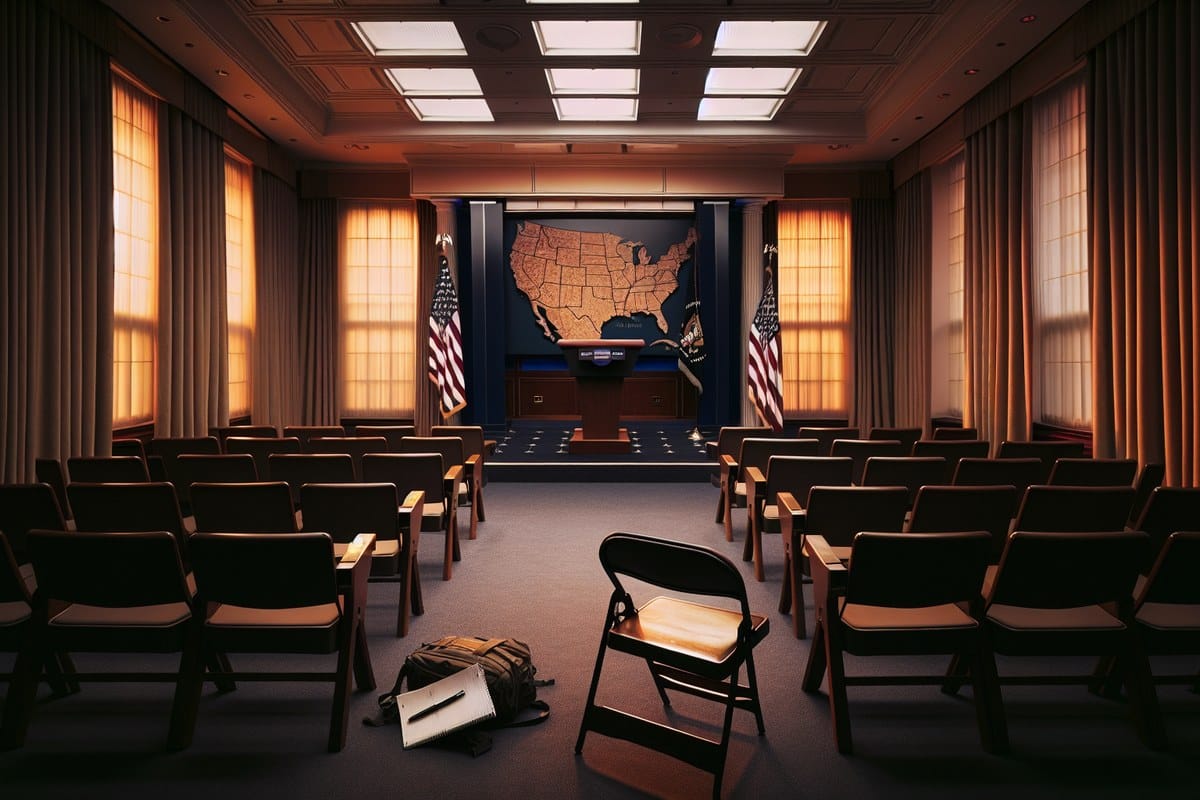
The news, in case you were busy pretending to care about the Super Bowl halftime show, is that the White House has threatened to ban the Associated Press from events because the AP declined to refer to the Gulf of Mexico as the “Gulf of America.” That is the sentence. I typed it twice to make sure I hadn’t hallucinated it. A press organization founded in 1846 is being told that its credentials depend on whether it will adopt, in its copy, the cartographic preferences of a single administration that has been in office for approximately three weeks.
I am old enough to remember when conservatives were the people who warned, in grave baritones at Federalist Society dinners, about the creeping politicization of language. I was in those rooms. I took notes. Someone once gave a forty-minute speech at the Mayflower about the tyranny of calling a tax a “revenue enhancement,” and the audience gave him a standing ovation and a plaque. I would like to know where those men are tonight. I suspect they are at a different dinner party, eating the same salmon, saying nothing.
Because this is not a fight about a gulf. A gulf does not care. The water off the coast of Galveston is indifferent to its own branding. This is a fight about whether the people who report on the government are allowed to use a word the government does not prefer, and whether the penalty for using that word is expulsion from the room. If that sentence does not alarm you, I would gently suggest you have not been paying attention, or you have been paying attention and decided you would prefer a cheerful evening.
My sister-in-law Judy, who works at the National Archives and has seen enough presidential paperwork to develop a permanent eye twitch, told me something over the holidays that I have not been able to stop thinking about. She said the thing that changes first is never the big thing. It is always the small administrative thing — the form, the letterhead, the footnote, the list of approved terminology. The big thing comes later, and by then the small thing has already done the work of making the big thing feel normal. I am paraphrasing. Judy is less polite.
I called an old colleague of mine, a retired press office veteran named Harlan Pettit who spent twenty-two years across three administrations and now raises heritage chickens in Virginia. He said what’s unusual isn’t that a White House is angry with a wire service. Every White House is angry with a wire service. He said what’s unusual is the demand. “Nobody ever told me what to call a body of water,” Harlan said. “You could yell about coverage. You couldn’t require a vocabulary.” Then he asked if I wanted half a dozen eggs and hung up.
This is the part of the column where I am supposed to remind you that the AP stylebook is not a sacred document and that naming conventions evolve and that, yes, “Denali” happened and the republic survived. Fine. Granted. Noted. The difference, which I shouldn’t have to point out but apparently do, is that those changes did not come with a threat attached. No one was told that their press pass depended on the vowels they used. There was no list of rooms you could be thrown out of for noncompliance. The word and the consequence were kept politely apart, which is, in fact, most of what a free press is.
What interests me most, and what I could not stop thinking about on the drive home from Eliza’s, is the silence of the other outlets. A few issued statements. Most did not. I understand the calculation — you do not want to be next, you do not want to lose the seat, you have a mortgage and a network and a mildly aggrieved spouse who wants you home by eleven. I understand. I have been in Washington for thirty years. The calculation is always the same calculation. It is also, cumulatively, how you end up in a country where the map is whatever the man at the podium says it is.
Someone at the table Saturday — I will not say who, because she reads this column and will call me — said that she thought the whole thing was “a distraction,” which is the word people in this town reach for when they would like permission to stop thinking about something. Everything is a distraction if you are distracted enough. A gulf is a distraction. A press ban is a distraction. A demand that reporters adopt the administration’s preferred nouns or be exiled from the building is, apparently, also a distraction. One wonders what, exactly, is not a distraction. The salad, possibly.
I am old-fashioned enough to believe that when the government tells a newsroom what to call a thing, and threatens punishment if the newsroom refuses, something has gone wrong that a cheese course cannot fix. I am old-fashioned enough to believe that the other newsrooms, the ones quietly tightening their own copy tonight just in case, are participants in that wrong and not bystanders to it. And I am old-fashioned enough to believe that the lobbyist at the end of the table, smiling into his wine, is the most American figure in the room — the man who has decided, pleasantly, that it is not his job to notice.
We will know the gulf by several names in the coming years. That is not the part that should worry you. The part that should worry you is what else we will agree to rename, quietly, in rooms where the penalty for the old word is the door.