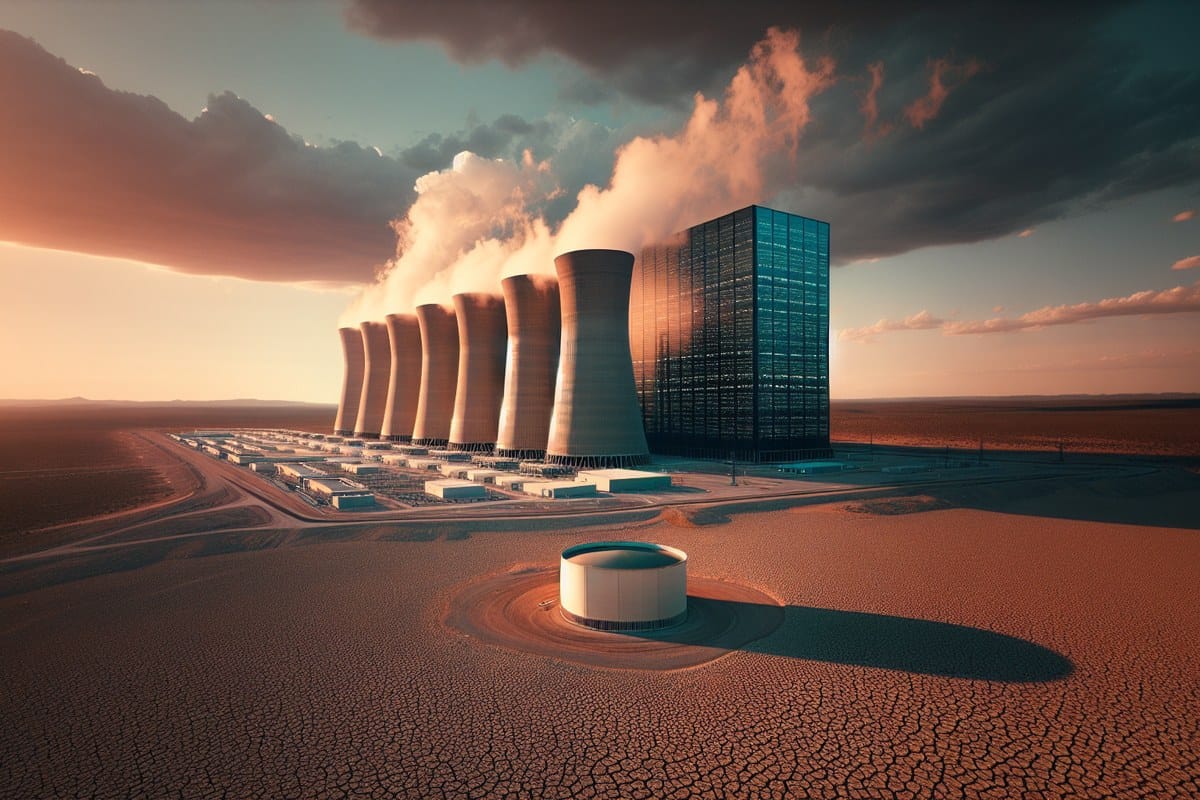
ABILENE, TX — Flanked by three men who together control more infrastructure than most G20 nations, President Donald Trump on Tuesday announced the Stargate Project, a $500 billion private venture to build out domestic AI supercomputing capacity, named — apparently without irony — after a 1994 Kurt Russell film in which a military-industrial wormhole unleashes a god on a confused civilian population.
The joint venture between OpenAI, SoftBank, and Oracle will begin with a 10-building campus in Abilene, Texas, a town chosen for its abundance of two things the American electrical grid is rapidly running out of: land, and the political will to ask what any of this is for. Ground has already been broken on the first data center, which will reportedly draw enough power at full tilt to run a midsize city and enough water to cool it to light-jog temperature.
“We are thrilled to partner on a project of this civilizational scale,” said Oracle chairman Larry Ellison, standing beside a president who last week pardoned the January 6 defendants and a SoftBank CEO whose last major American bet was WeWork. Sam Altman, who runs OpenAI, added that Stargate would “unlock benefits for all of humanity,” a phrase he has now used in six separate announcements without specifying which humans or which benefits.
The $500 billion figure, which exceeds the annual GDP of Norway, is aspirational: only $100 billion has been committed, and the rest will be raised through a financing structure that industry analysts describe as “mostly vibes and Middle Eastern sovereign wealth.” The press release did not clarify who is on the hook if the vibes sour.
“What we’re looking at is essentially a new category of infrastructure,” said Dr. Priya Mendenhall, a grid-load researcher at the Rocky Mountain Institute who was not involved with the project. “A data center of this scale consumes roughly the freshwater equivalent of 80,000 households and enough electricity to power Pittsburgh. In exchange, society receives a language model that can almost reliably generate a wedding toast.”
The announcement comes as a historic cold wave grinds across the United States and Canada, leaving pipes burst from Minneapolis to Mobile and reminding Americans that their existing grid, the one that has existed for a century, still cannot handle a Tuesday in January. Texas, which will host the Stargate flagship, last experienced a cold snap that killed 246 people when the grid failed in 2021. The state has since addressed the problem by asking nicely.
Environmental groups expressed what one spokesperson called “the usual concerns, which, as usual, will be ignored.” The Sierra Club noted that Stargate’s projected water withdrawals in drought-stricken West Texas would rival those of the region’s agricultural sector, and that the promised switch to “advanced cooling” is industry shorthand for “the same cooling, but we called it advanced.”
Altman, for his part, has argued that the energy demands of AI will be offset by AI itself, which will eventually discover cleaner forms of energy. This is the technological equivalent of borrowing money from your parents to bet on a horse that you insist will, upon winning, pay your parents back. The horse, in this metaphor, is also writing your college essays.
On Capitol Hill, Republicans hailed the announcement as proof of America’s renewed industrial vigor; Democrats hailed it as proof of the need to regulate a technology they have so far regulated by holding a hearing in which a 78-year-old senator asked ChatGPT whether it was sentient and accepted “no” as the final word on the matter. Both parties agreed the jobs would be great, though neither specified for whom. The Abilene site is projected to employ roughly 1,500 permanent workers, or about one job per $333 million of investment.
“I just want to know where the water’s coming from,” said Darlene Koopman, 63, who runs a cattle operation twelve miles east of the proposed site and who has been rationing irrigation since September. “They keep saying ‘advanced closed-loop something.’ I asked the man from Oracle if that meant they weren’t using the aquifer and he said it meant they were using less of the aquifer. So.”
Stargate is the latest entry in a growing genre of trillion-adjacent tech announcements staged as geopolitical theater: a CEO, a president, a number with too many zeros, and a promise that this time the transformative technology will be built here, using our power, on our soil, with benefits accruing to a holding company in the Cayman Islands. The DeepSeek panic rattling Silicon Valley this week — in which a Chinese startup appears to have matched OpenAI’s performance at a fraction of the compute — has only sharpened the administration’s appetite for spending more, faster, on bigger.
A reporter asked Altman at the press conference whether, given DeepSeek’s results, $500 billion was perhaps more compute than strictly necessary. Altman smiled the smile of a man who has raised money in every interest rate environment known to God, and said the question demonstrated a fundamental misunderstanding of scale.
The first Stargate buildings are expected to come online in late 2026. Somewhere in West Texas, a cow is already being asked to share.