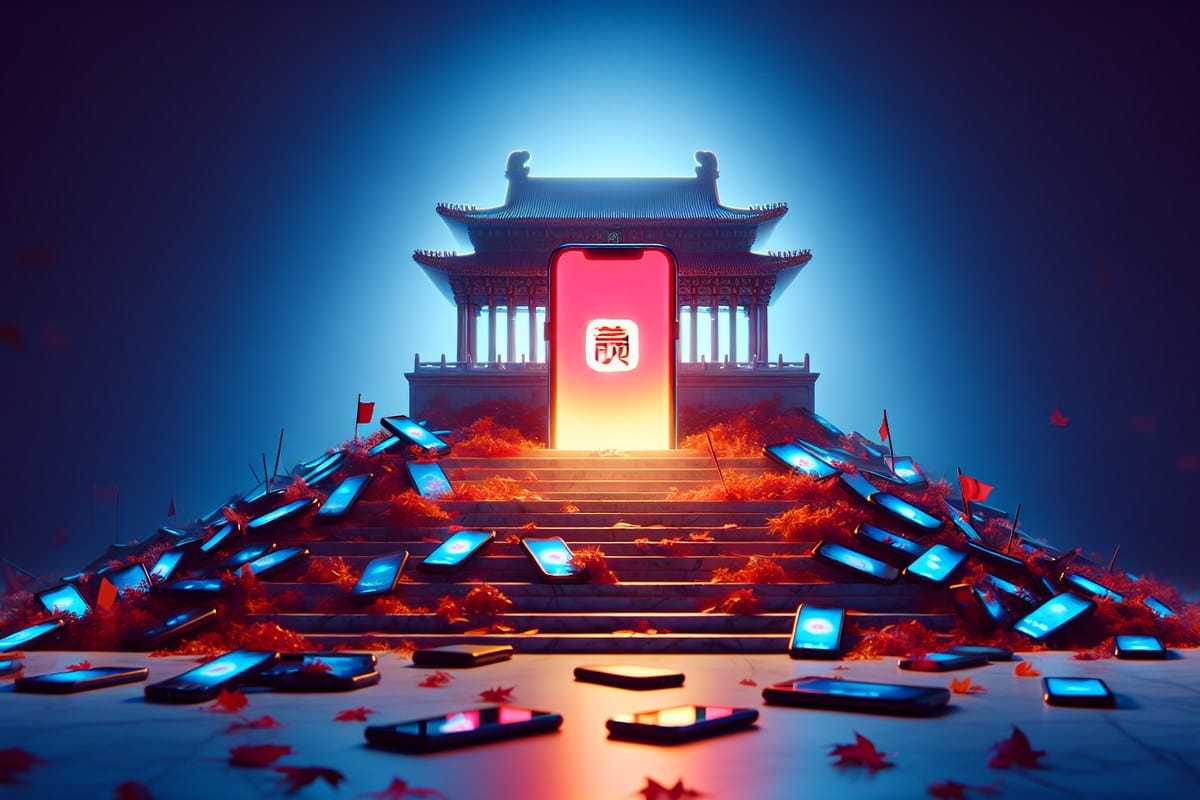
WASHINGTON, D.C. — Hours after the Supreme Court unanimously upheld the law permitting a federal ban on TikTok, roughly 3.4 million American teenagers had already downloaded Xiaohongshu, an app whose name translates to ‘Little Red Book’ and whose terms of service are available exclusively in Mandarin. Within the same news cycle, several of them had posted dance videos captioned ‘hi chinese spies, my dad’s SSN is in the caption.’ Congress, which spent two years warning that TikTok was a national security threat because the Chinese government could theoretically access American user data, released a statement calling the migration ‘not ideal.’
The ruling itself was a tidy piece of legal reasoning. The Court concluded that forcing ByteDance to divest from TikTok did not violate the First Amendment because Americans remained free to post brain-rot content on any number of other surveillance platforms, including several owned by a man who currently sits two desks away from the Resolute Desk. The opinion noted, in a footnote, that the ruling addressed only this specific app and did not in any way constitute a broader theory about how data flows across international borders in 2025, a question the Court politely declined to answer on the grounds that nobody on the bench uses the internet.
‘There’s a prevailing assumption in policy circles that the problem with TikTok is fundamentally about one company in one country,’ said Dr. Priya Venkatesh, a senior fellow at the Center for Applied Digital Sovereignty. ‘The problem with TikTok is that it works. You can swap out the flag on the server farm and the algorithm will still know that you cried at a dog video in October of 2022. That is now a permanent feature of being alive.’
Xiaohongshu, for its part, appears to have been completely unprepared for its sudden elevation to the number-one free app in the App Store. By Friday afternoon, its trending page featured a baffled Shanghai skincare influencer trying to understand why approximately 900,000 Americans had shown up in her comments calling her ‘my Chinese spy’ and asking for homework help. A second creator, a farmer in Yunnan province, reportedly gained 2.1 million followers overnight by posting a single video of a duck.
The environmental footprint of the migration has already raised eyebrows in a sector of the tech industry that occasionally pretends to care about such things. Shifting a user base of 170 million people across server infrastructure in roughly seventy-two hours represents, by one back-of-the-envelope estimate, the carbon equivalent of flying every member of Congress to Davos and back, which is coincidentally something many of them were planning to do anyway.
Meta and Google, both of which spent the past eighteen months quietly lobbying for the divestiture law while publicly maintaining that they had no opinion on the matter, released near-identical statements welcoming users to Instagram Reels and YouTube Shorts, platforms that have spent the last four years successfully cloning TikTok’s product while failing to clone any of the things that made it fun. Instagram’s head of product, Jasper Klein, called the ruling ‘an exciting inflection point for creator-first storytelling,’ a sentence that has never meant anything and will never mean anything.
Generational fault lines emerged within hours. Americans over the age of 45 largely greeted the ruling as a long-overdue victory against Chinese influence, citing concerns about data harvesting they had learned about from a Facebook post they did not verify. Americans under the age of 25, who had grown up assuming that every app on their phone was quietly selling their location to the highest bidder as a baseline condition of existence, interpreted the ruling as yet another instance of adults confiscating something because they didn’t understand it and felt left out.
‘My mom asked me if I was worried about the Chinese government having my data,’ said Maya Ortiz, 17, a high school junior in Phoenix who declined to give the name of her new preferred platform because ‘you’ll just ban that one too.’ ‘I told her the Chinese government has been watching me eat Hot Cheetos in bed since I was twelve. I’ve made peace with it. She’s the one who still uses Temu.’
At a press conference outside the Capitol, Senator Roy Hackett (R-Tenn.), one of the bill’s chief architects, celebrated the ruling as ‘a decisive win for American digital sovereignty’ before pulling out his own phone to record a victory selfie on an app that, per its own disclosures, shares user data with at least 1,400 third-party advertising partners across eleven jurisdictions. When asked whether he was concerned about the sudden American embrace of Xiaohongshu, Hackett squinted, said ‘the what,’ and returned to his selfie.
ByteDance indicated it would continue fighting the ruling while also preparing, as a contingency, to sell TikTok’s U.S. operations to a consortium that reportedly includes a private equity firm, two sovereign wealth funds, and a cryptocurrency entrepreneur who last year tried to buy the Mona Lisa and turn it into an NFT. National security experts have so far declined to comment on whether this outcome is meaningfully better than the status quo.
The Federal Trade Commission, which could theoretically regulate the underlying data practices that made TikTok a concern in the first place, was not available for comment, as its entire digital privacy division had been reassigned earlier in the week to a new cost-cutting task force tasked with reviewing whether government printers should be allowed to print in color.
For most users, the transition has been seamless in the way that all transitions within the attention economy are seamless: a new app, a new feed, a new algorithm learning their preferences by Thursday. By Friday night, Xiaohongshu’s For You page was already serving American users videos of other American users complaining that Xiaohongshu’s For You page wasn’t as good as TikTok’s, a content loop so efficient it may in fact be the point.
Somewhere in a hearing room in the Longworth Building, a staffer was reportedly drafting a memo titled ‘Little Red Book: Possible Concerns.’