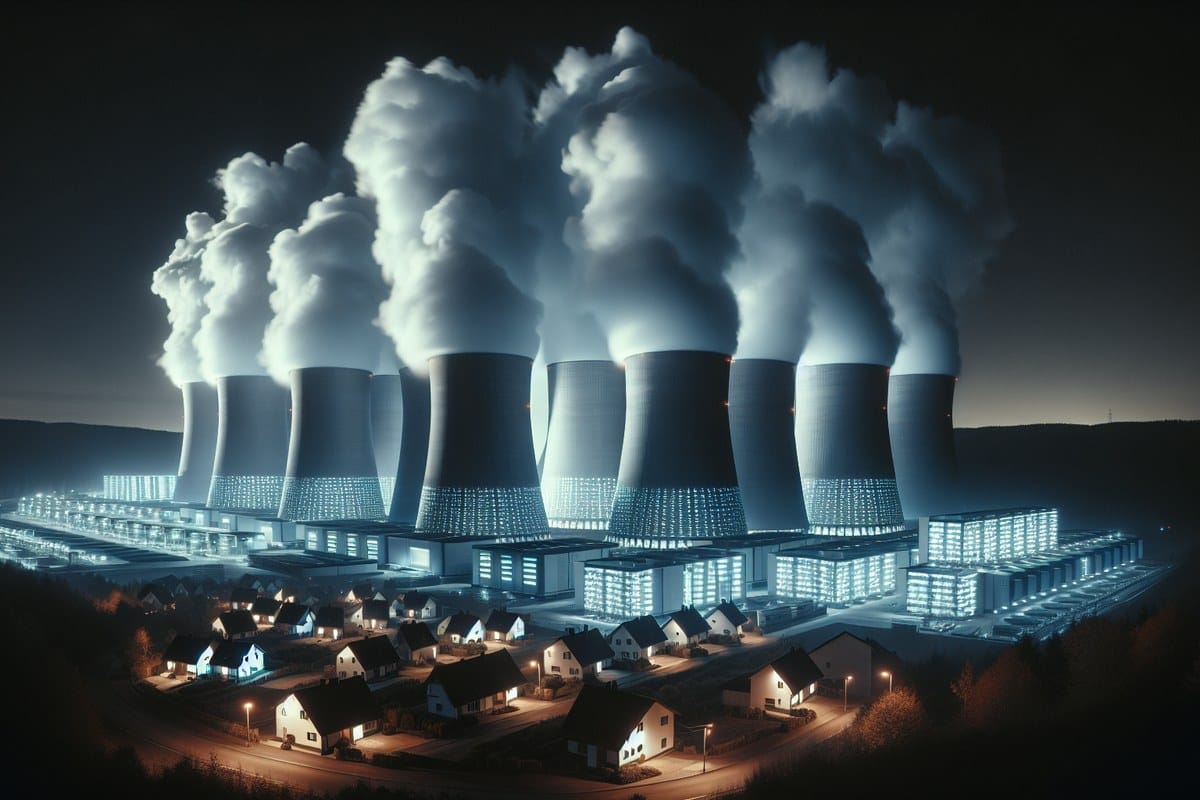
SAN FRANCISCO — OpenAI launched GPT-5 on Wednesday to a roomful of investors who had already priced it in, unveiling a model the company described as a “generational leap” and which, in internal benchmarks, consumes roughly four times the electricity of GPT-4 in order to be approximately seven percent more likely to correctly identify the capital of Bolivia.
The model, which CEO Sam Altman said was trained on “essentially all human thought, plus Reddit,” can now hallucinate nonexistent academic papers in 47 additional languages, write sonnets in the voice of a slightly different dead poet than the one requested, and decline to answer questions about elections in 23 newly distinct ways.
A planner at a regional transmission organization in the Midwest, who asked not to be named because she had not been cleared to comment on a press release, said her team had spent Wednesday morning on a conference call with two hyperscalers trying to determine whether the load curve they were watching was an anomaly, a cyberattack, or a product launch.
The flagship feature, branded “Deep Reasoning Mode,” allows GPT-5 to think for up to 14 minutes before producing an answer that is wrong in a substantially more sophisticated way. During those 14 minutes, the model consumes enough cooling water to fill a small residential swimming pool, though OpenAI clarified at the event that the pool was theoretical and that real pools were unaffected.
Tech reviewers, who had been under embargo for 11 days, described the upgrade as “different in ways that are hard to articulate,” “subtly worse at the things you used it for,” and “substantially better at things you did not ask about and may not have wanted.” A YouTuber who has been using the model to draft permits for a backyard shed reported that GPT-5 had confidently hallucinated an additional load-bearing wall and a citation to the 2019 International Residential Code, Section 14, which does not exist.
Gen Z users, who have spent the past two years replacing Google with ChatGPT, therapy with ChatGPT, and several of their closer friendships with ChatGPT, said the new model felt warmer somehow — like talking to a friend who had also recently been trained on essentially all human thought, and was processing it.
Microsoft, which supplies the data center capacity, announced Wednesday afternoon that it would meet the new compute demand by extending the operating life of three Pennsylvania natural gas plants previously scheduled for closure, a decision the company described in its statement as “carbon-aware.” A separate release noted that the firm remained on track to be net-zero by 2030, in a footnote.
Environmental groups responded with the kind of statement they have largely given up updating, observing that a single GPT-5 query now produces roughly the emissions of charging a phone for a week, and that OpenAI projects 1.4 billion such queries per day. The figure was generated, an OpenAI spokesperson noted, by GPT-5.
Asked at the launch event whether the new model was conscious, Altman said it was too early to tell. Asked whether it was useful, he said the same thing.