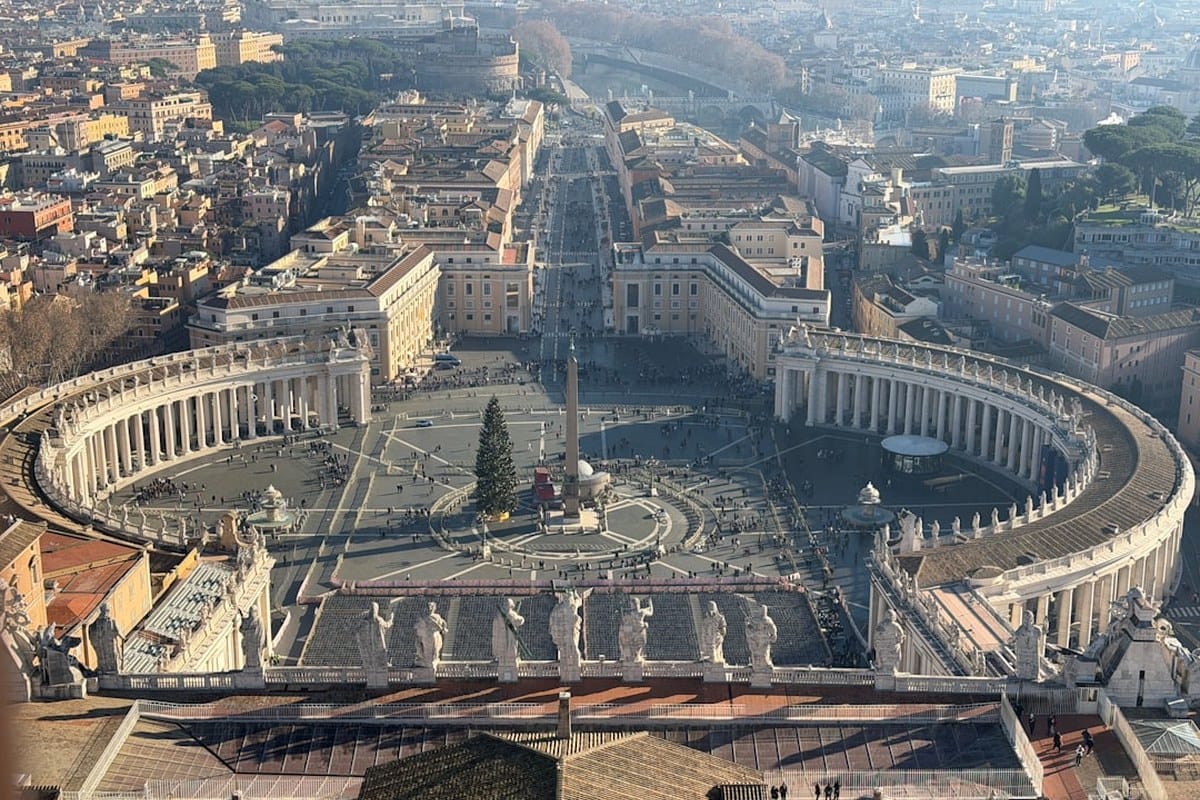
What does it say about us that the moment a man from suburban Chicago put on the white cassock, the immediate national project was determining whether he was one of ours or one of theirs?
The College of Cardinals, in their wisdom or their fatigue, elected an American to lead 1.4 billion Catholics. Within ninety minutes the question on American television was not what this meant for the global church but whether His Holiness had ever liked a tweet, and if so, whose.
My friend Eliza had us over a week ago Saturday, the kind of evening where the salmon is excellent and the conversation has been pre-cleared by everyone’s communications director. A bipartisan lobbyist I’ll call Tom — that is not his name and it does not matter — pulled out his phone between the salad and the entrée and announced he had located the new pope’s college thesis and that it was, quote, a problem for the right. Across the table, a woman who runs a think tank I will not embarrass declared that actually, no, the new pope had said something in 2012 that made him essentially one of ours. Within twenty minutes the assembled company had divided the Vicar of Christ into two functional caucuses and was preparing him for markup.
There is a particular American disease, and I have written about it for thirty years, in which we cannot encounter a global event without first running it through the domestic blender. A pope is elected: which side won? A foreign leader dies: was he soft on us, or hard? A capital floods: did the relief contract go to a firm with the right donors? We are no longer capable of registering that something has happened which is not, fundamentally, about us.
My sister-in-law Judy, who works at the National Archives and has the temperament of a woman who has watched primary documents survive five administrations, called me Sunday and said, Maggie, do you understand that they put him on the cover of a magazine in a MAGA hat that someone Photoshopped on. I said I did. She said, And the other side put him in a Bernie sweater. I said I had seen that one too. She was quiet for a moment and then she said, He has been the pope for nineteen days.
The White House, to its credit, restrained itself for nearly a full afternoon before issuing a statement noting that the Holy Father was an American and that Americans, broadly, were doing very well at this time. A senator from a state I will let you guess introduced a resolution congratulating our pope. The Speaker, asked whether he would attend the installation, said he would have to consult his schedule, which is what people in Washington say when they have not yet been told what to think.
It used to be that the election of a pope was an occasion for, at minimum, a respectful pause. You did not have to be Catholic. You did not have to care. You were simply expected to register that something had happened that was larger than your party’s quarterly fundraising goals. We have lost that capacity. We have lost it with weddings and funerals, with hurricanes and foreign elections, with the deaths of writers we did not read. Everything is now a referendum on the only subject we recognize.
I asked Eliza, on the way out, whether she thought the new pope would visit Washington in his first year. She said she hoped so, because she had questions for him. I asked what kind of questions. She said, You know, the kind everyone is asking.
I am, of course, just asking myself. But a country that cannot let a pope be a pope for forty-eight hours before assigning him a party registration is a country that has run out of things it considers larger than itself. That is not a culture war. That is a culture that no longer believes anything is bigger than the room it is standing in.