Quick: name the last chair of the Democratic National Committee. Don’t Google. I’ll wait. If you got it on the first try you are either being paid to know or you are the kind of person I try to avoid seating next to at dinner, because you will want to talk about it, and I have already spent thirty years pretending to care.
I was at Eliza’s on Saturday night — she made the short ribs, the ones she learned from a cookbook she now refers to as “problematic,” though she has not stopped making the short ribs — when the news came in that Ken Martin of Minnesota had been elected to run the party. Eliza, who has sat through every post-election autopsy since Mondale and has the liver to prove it, put down her wine glass and said, “Oh good. A Ken.” There was a silence at the table that I would describe as neither hopeful nor sad. It was the silence of people who have been here before, and who suspect they will be here again, in four years, with a different Ken.
The new chair gave a speech about “meeting voters where they are,” which is the phrase the party has been using since I had brown hair. Voters, as far as I can tell, are where they have always been — at work, in traffic, in the checkout line wondering why a bag of grapes costs nine dollars — and the Democratic Party continues to arrive at that location approximately eighteen months late, slightly out of breath, with a PowerPoint.
“This is a structural realignment moment,” Dr. Alan Brigham, a political scientist at one of those Washington think tanks whose name contains the word ‘Institute’ twice, told a cable panel I watched with the sound on for reasons I cannot reconstruct. “The party now has a real opportunity to rebuild from the grassroots up.” The party has had, by my count, a real opportunity to rebuild from the grassroots up in 2004, 2010, 2014, 2016, and 2022. At some point a real opportunity that arrives every eighteen months stops being an opportunity and starts being a hobby.
What the DNC chair race actually was, for those of you fortunate enough not to have followed it, was four months of state party functionaries mailing each other position papers about “the path forward” while the country outside the conference hotel continued to come apart in ways the position papers did not address. One candidate promised to hire more organizers. Another promised to fire some consultants. A third promised to do both, somehow, with the same money. The winner promised “a fifty-state strategy,” which is what the loser of every DNC race since Howard Dean has been promising, because it polls well among the four hundred and forty people who vote in DNC races.
My friend who lobbies on both sides of the aisle — I will call him bipartisan in the sense that he has clients who contradict each other and an accountant who does not ask — put it more crisply over the cheese course. “They picked the guy who will not embarrass them,” he said, “which is a real downgrade from picking the guy who might save them.” He was already reaching for the manchego. He is always already reaching for the manchego.
My sister-in-law Judy, who has spent her working life at the National Archives and who possesses the particular calm of a woman who has filed things that outlasted presidencies, emailed me Sunday morning with a one-line note: “We have a file on every DNC chair since 1848. I have not been asked to pull one since 1996.” I read that line three times. It is, I think, the most honest political analysis I have read this year, and it was delivered by a woman whose job is literally to remember things professionally.
Here is what nobody at Eliza’s table was willing to say out loud, though we were all thinking it between bites: the Democratic Party does not have a chairman problem. It has a nerve problem. It has spent a decade outsourcing conviction to committees, focus-grouping its spine into a noodle, and then acting shocked when voters decline to turn out for a party that will not tell them, in a complete sentence, what it is for. You cannot consultant your way out of that. You certainly cannot Ken your way out of it.
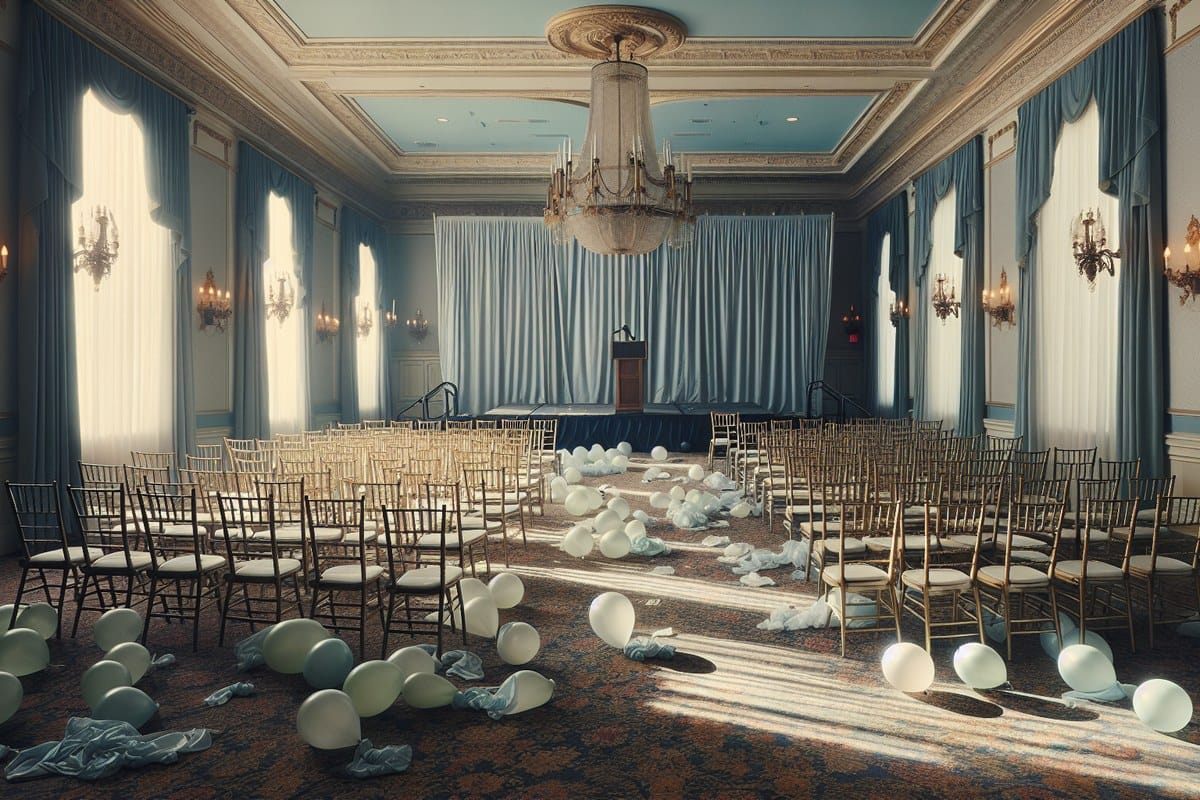
And yet the coverage this weekend treated the election of a new chair as though something had happened. Something did happen. A conference room in National Harbor was booked, a balloon drop was executed, a man delivered remarks, and the machinery that produced three consecutive losses to a candidate the party keeps assuring us is unelectable rotated one notch clockwise and resumed humming. This is not renewal. This is a screensaver.
I will tell you what I told Eliza as we were clearing the plates. The danger is not that Ken Martin will fail. Ken Martin may well succeed at the job as the job has been defined, which is raising money and not embarrassing the donors. The danger is that the people who run the opposition party in a country sliding somewhere it has not been before have decided that the correct response to an emergency is a procedural election, a unity speech, and a press release about “the work ahead.” The work ahead, as near as I can tell, is the same work that was behind, performed by a new man with the same first name.
I am not asking the Democrats to panic. I gave up asking the Democrats to panic somewhere around the second Obama midterm. I am asking them to notice that the building is on fire, and that the fire does not particularly care which Ken is holding the clipboard. If they cannot manage that — and this weekend suggests they cannot — then we are not watching a party rebuild. We are watching it redecorate. And the people who redecorate during a fire are not, historically, the people we remember fondly.