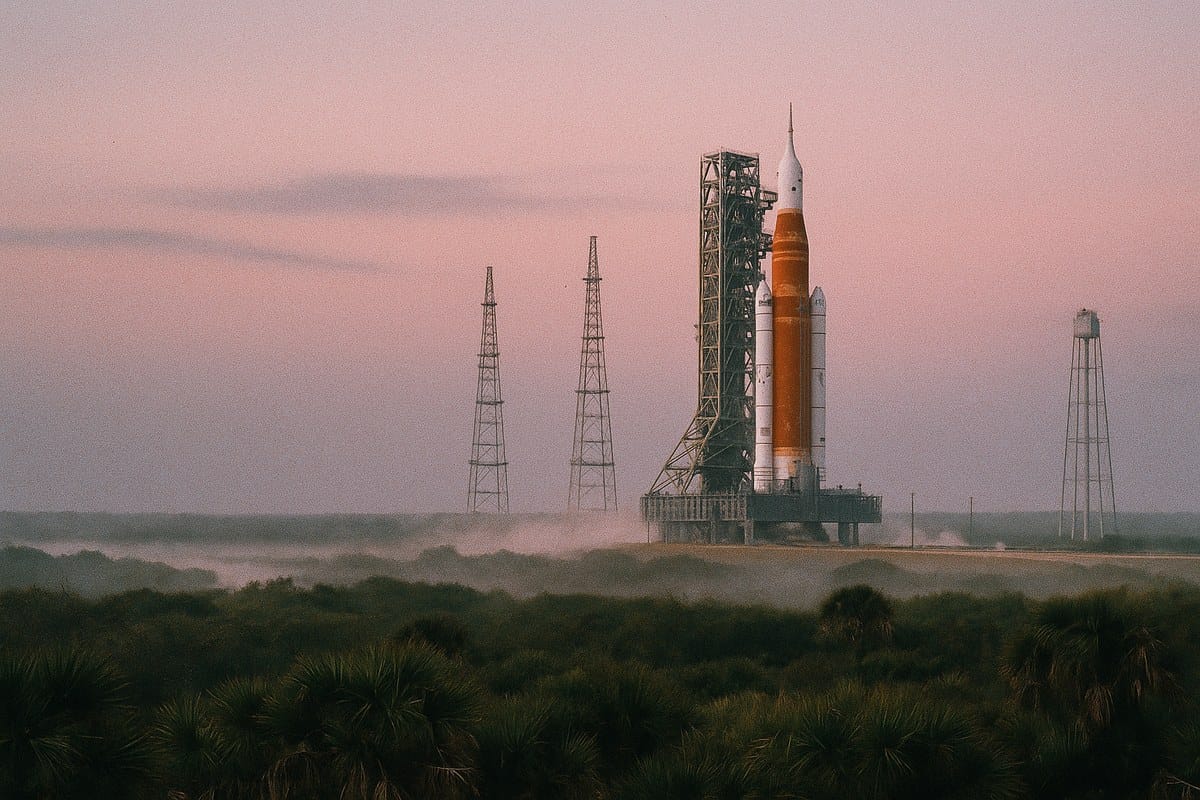
KENNEDY SPACE CENTER, Fla. — NASA on Wednesday launched the Artemis II crew on the first mission to send humans toward the Moon since 1972, a 54-year gap the agency chose to close, for reasons no one has adequately explained, on April 1st.
The four astronauts lifted off at 8:17 a.m. Eastern aboard the Space Launch System rocket, at which point NASA’s press office pivoted immediately to the mission’s most difficult phase: convincing a scrolling, suspicious public that the launch was, in fact, a real thing that had really happened on the actual calendar day of April Fools’.
“We understand the timing looks funny,” said Rennick Alvarado, a public affairs officer standing in front of a still-smoking launch pad. “It is not, however, funny. It is a rocket. The rocket is going to the Moon. We have receipts.”
By 9 a.m., #ArtemisIIisFake was trending on three platforms, buoyed largely by users under 40, a demographic that has now spent its entire conscious life being told humans used to go to the Moon and being asked to take that on faith. NASA’s livestream drew 18 million concurrent viewers, roughly a third of whom appeared in chat asking whether this was a teaser for a Netflix series.
The generational disconnect is not entirely misplaced. The last time humans traveled to the Moon, a gallon of gas cost 36 cents, phones were tethered to walls by cords, and the concept of a brand “pivoting to lunar content” would have registered as either a stroke or a code. Wednesday’s launch was carried live on TikTok alongside a video of a raccoon operating a Keurig.
Corporate tie-ins arrived within the hour. Duolingo posted its owl mascot in a spacesuit. A meal-kit company announced a limited Moon Landing Box containing freeze-dried lasagna and a QR code. A cryptocurrency called LUNA2 appeared, crashed, and was delisted before the rocket cleared low Earth orbit.
Environmental researchers noted that the launch consumed roughly 735,000 gallons of liquid hydrogen and oxygen, plus enough solid rocket fuel to, in the words of one climate economist at the Atlantic Heartland Project, “make the entire premise of a reusable tote bag feel like a personal insult.” NASA countered that the emissions were “one-time,” a claim complicated by the four additional Artemis flights already on the manifest.
The crew — Commander Reid Wiseman, Pilot Victor Glover, and Mission Specialists Christina Koch and Jeremy Hansen — will loop around the Moon over ten days without landing, a decision the agency has taken great pains to explain is a “test flight” and not, as some corners of the internet have suggested, “chickening out.”
Asked whether the April 1 launch date had been raised internally as a public-relations risk, mission director Aparna Chellappa of NASA’s Exploration Systems office paused for a long moment. “We looked at the launch window,” she said. “The launch window looked back at us. We made peace with it.”
The capsule is scheduled to splash down in the Pacific on April 11, at which point NASA expects to spend an additional six to eight hours convincing the public that it did.