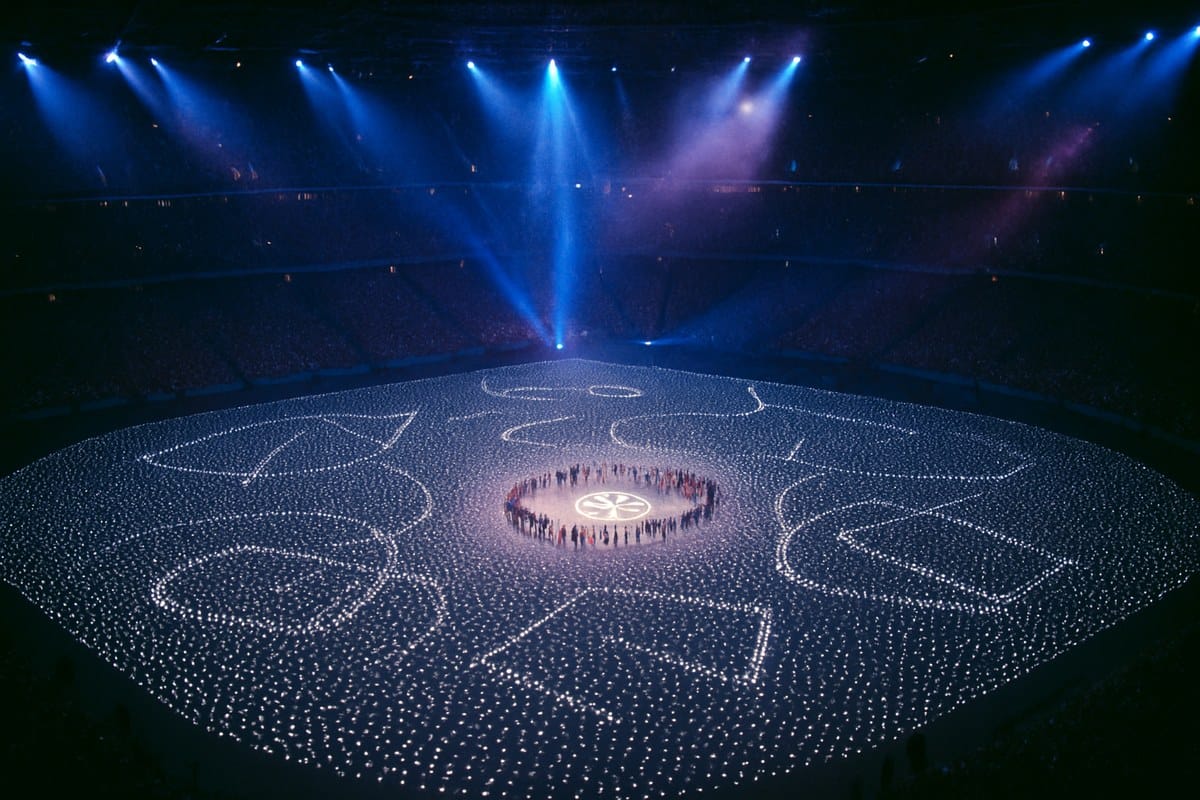
I sat down Thursday night with a beer and a notebook to watch the XXV Winter Olympics open in Milan, and what I got was the largest indoor LED show in human history followed, eventually, by some people from Lithuania carrying a flag.
I counted. Ninety-two minutes of drones, light grids, and what the broadcast kept calling “immersive narrative segments.” Eight minutes of athletes walking. The luger from American Samoa got roughly four seconds of camera time. A floating cube representing “the spirit of alpine collaboration” got two full minutes and a key change.
Coach DiMaggio used to say that pageantry is what you do when you don’t trust the game to sell itself. He said it about a halftime show in 1981 and I think he’d say it again about whatever was happening on my television, which at one point appeared to be a hologram of Leonardo da Vinci skiing.
Then they lit the cauldron. I’m not going to tell you how they lit the cauldron because if I describe it out loud my wife is going to ask me again why I’m yelling at the TV at 9:40 on a school night. I’ll just say it involved a child, a robot, and what I can only describe as a confused-looking goat.
I called Ray Kowalczyk during the second commercial break. Ray coached wrestling in Steubenville for thirty-one years and watches every Olympics start to finish out of what he calls “duty.” Ray said, and I’m quoting him exactly, “Duke, they spent more on the opening than my entire high school spent on heat in the 80s, and we still beat Mingo Junction.” Ray is not wrong about most things.
Then this morning the figure skating team event started, which is a competition where the same skaters who will compete individually next week skate the same programs they will skate next week, except scored as a team, so that countries with deep benches can collect a bonus medal for being countries with deep benches. Russia used to win it every time until they weren’t allowed to anymore. Now Japan probably wins it. The whole thing exists so that NBC has something to put on at 4 a.m. Eastern.
I want to be clear: I do not blame the skaters. The skaters are incredible. The skaters are doing quadruple jumps off a four-inch blade in front of a billion people while wearing rhinestones glued directly to their skin. Petey Corrigan from the old paper used to say that figure skaters are the toughest athletes nobody calls athletes, and Petey was right about that and also about the diner on Route 30. I respect the work. I just don’t need the work served to me in three different formats.
What I miss — and I know this makes me an old man yelling at a snowflake — is when the opening ceremony was a parade and a song and somebody lit a torch and then we went to bed. You woke up and there was hockey. The hockey was the thing. The hockey did not need to be introduced by a forty-foot inflatable Pavarotti.
The athletes themselves, the ones the camera finally found around the ninety-third minute, looked the way they always look: cold, exhausted, twenty-two years old, holding their phones up to film the crowd filming them. A short-track speed skater from Hungary was crying. A Norwegian biathlete was eating what appeared to be an entire baguette. That part I liked. That part is what the Olympics actually is, before the cube floats in.
I’ll watch the rest of it. I always do. I’ll complain about the team event and then I’ll be up at 3 a.m. watching the team event, because that’s the deal you make when you’re a person who loves sports — you take the drones to get to the downhill. You take the floating cube to get to Petey’s tough kids in rhinestones.
Denise is bringing chili over for the men’s downhill on Sunday. She says it’s from a podcast.